Emilie Mauricio
August 31, 2026
•
5 min read

There's a moment most people recognize when they hear it described.
Not the passive thought — the "I really should deal with this" that floats by and disappears. The other one. Where something shifts and you're not just thinking about getting help anymore. You're actually doing something about it.
You feel momentum. Urgency, even. You want to act on it right now, before the feeling passes.

You look for a therapist covered by your insurance. The search tool is confusing. Half the providers listed aren't taking new patients. The ones who are have a three-week wait.
You call your insurance company to ask for help navigating it. You're on hold. You get asked about your deductible. Somewhere in the conversation, a form appears that needs to be filled out before anything gets approved.
That process is called prior authorization — the insurance industry's way of deciding whether your care is necessary enough to cover before it happens. 94% of physicians say it delays necessary care. (AMA, 2023) For mental health, where timing is everything, that delay doesn't just slow things down. It ends them.
By the time the paperwork clears — if it clears — the urgency has faded. Life moved on. You told yourself you'd try again later.
With most medical issues, a delay is inconvenient but manageable. You book the appointment, you wait, you go.
Mental health doesn't work that way. The decision to get help is emotional, not logistical. It happens in a specific state of mind — and that state of mind doesn't hold through a three-week wait and a stack of forms.
When someone is finally ready, they need the door to be open. Not cracked. Not "call this number and we'll see." Open.
Nearly 3 in 4 employees will experience mental health challenges at some point in their lives — yet an estimated 80% never seek help. (Talkspace, 2024)
That gap isn't mostly about stigma or denial. It's about a system that isn't positioned to catch people when they're actually ready.
Most mental health resources are built for people who have already decided, already navigated the insurance system, already waited out the friction. They're built for people with more runway than most people have in that moment.

It's not better resources. It's earlier ones.
When someone already has a wellness app as part of their daily life — checking in on their mood, journaling, using it on ordinary days — reaching out for more support when a hard moment hits isn't a new decision requiring new effort. It's a next step. The path is already familiar. The friction that derails a crisis response barely exists.
Two in five workers worry they would be judged if they shared about their mental health at work. (NAMI Workplace Poll, 2025) But stigma shrinks when mental wellness is already normalized — when it's something you do every day, not something you only turn to when things break down. The habit itself changes the relationship.
You don't have to wait for a hard moment to start building the habit.
The most protective thing you can do for your future self is to have support already in place — not as a backup plan, but as part of your normal routine. A mood check-in on a Tuesday. A journal entry when something's nagging at you. A breathing exercise that takes three minutes and doesn't require you to be in crisis to use it.
That's what Brightn is built for. The ordinary days that determine how you handle the hard ones. And when you do need more — when the window opens and you want to talk to someone — the path to a real therapist is already right there. No cold start. No forms. No hold music.
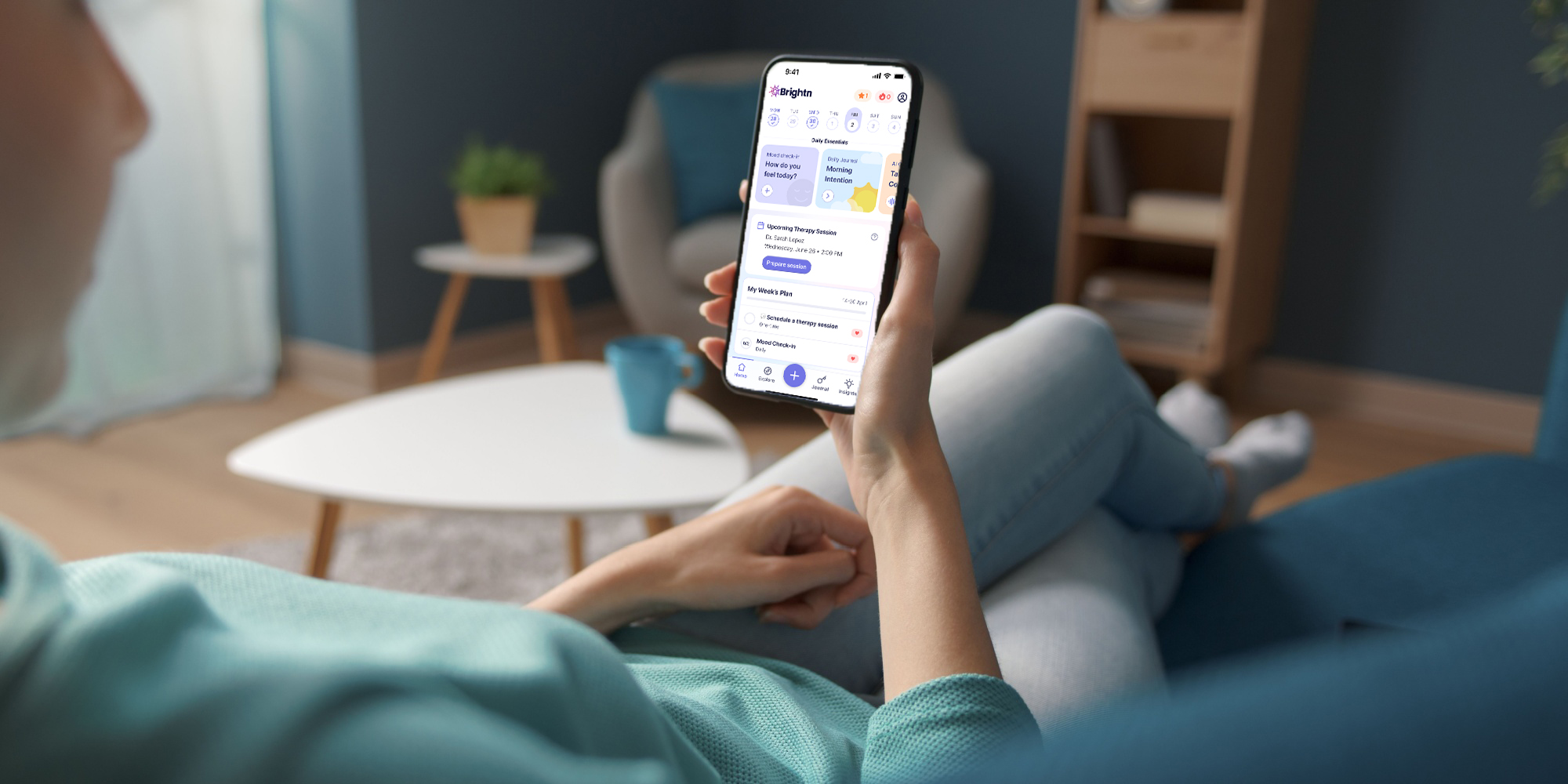
Brightn is a mental wellness app for everyday life — mood tracking, journaling, guided exercises, and access to therapy when the moment calls for it. Download Brightn below and build the habit before the hard moment arrives.
Several things converge at the worst possible time: insurance navigation, prior authorization requirements, limited provider availability, and apps or hotlines designed only for people already in crisis. Each one is a small barrier. Together, they're often enough to close the window of readiness before anyone gets through.
Prior authorization is the insurance process that determines whether your care is covered before you receive it. For mental health, this often means submitting paperwork and waiting for approval right when someone is most motivated to get help. 94% of physicians say it delays necessary care — and for mental health, that delay frequently means people give up entirely.
Start with what's already in your hands. A mental wellness app like Brightn helps you build a daily habit of checking in on your mental health — and when you're ready to talk to someone, the path to a therapist is already built in. No new accounts, no new systems to figure out while you're already overwhelmed.
Completely normal, and very common. The window of readiness opens and closes based on what's happening in your life. The most effective way to act on it is to reduce the friction between the moment of wanting support and the moment of actually getting it. Having a wellness habit already in place is one of the most reliable ways to do that.
Apps that integrate wellness tools with telehealth access — like Brightn — are typically faster than navigating insurance directories because you're not starting from zero. If you're in immediate crisis, the 988 Suicide and Crisis Lifeline is available 24/7 by call or text.