For Immediate Release
Cedar Rapids, IA and Des Moines, IA, August 24, 2026
OpenLoop, a national leader in telehealth-enabled clinical services, and Brightn, an AI-powered upstream mental wellness platform, today announced a strategic partnership to expand access to clinically-informed, preventive mental health support across healthcare, employer, and payer-aligned networks nationwide.
The partnership connects Brightn's AI-driven, daily mental wellness experience with OpenLoop's nationwide clinical infrastructure, creating a seamless pathway from early emotional awareness to timely clinical care while maintaining appropriate clinical governance. For the first time, Brightn users can move from a daily check-in to a session with a licensed therapist without ever leaving the app.
Nothing Exists Between Sessions
Behavioral health continues to outpace the broader medical trend, with utilization rising 62.6% from 2018 to 2024, according to PwC's Behind the Numbers 2027 report. At the same time, the World Health Organization estimates that depression and anxiety cost the global economy nearly $1 trillion each year in lost productivity. Yet the structure of care has barely changed.
Someone sees a therapist for 50 minutes and then goes without support for the other 167 hours of the week. Skills are not reinforced. Patterns go unnoticed. Distress escalates quietly until it becomes a crisis. Meanwhile, traditional employee assistance programs see utilization in the low single digits, which means the benefit exists on paper for most people and nowhere else.
This partnership was built to close that gap from both directions: daily support that people actually use, connected to licensed clinical care the moment it is needed.
A Clear Path From Daily Support to Human Care
Brightn is a wellness platform, not a clinical service. It does not diagnose, treat, or provide medical advice. What it does is help people notice how they are doing over time, and make it easier to reach a person when they want one.
Through reflective journaling and daily check-ins, users build awareness of their own emotional patterns. That experience is built with clinical input from Dr. Ahmed Darwish, a licensed clinical psychologist who works alongside the Brightn team to stress test and refine how the platform responds. That work focuses on keeping responses clinically informed, holding the AI inside appropriate boundaries, and making sure that when safety-related content appears, the experience surfaces crisis resources such as the 988 Suicide and Crisis Lifeline and the Crisis Text Line.
OpenLoop adds a human pathway alongside those resources. Users who want to talk with a licensed professional can schedule and pay for a session with a therapist from OpenLoop's credentialed network directly within the Brightn app. All clinical judgment, including assessment, diagnosis, and any course of treatment, rests with the licensed OpenLoop clinician.
The goal is to shorten the distance between noticing something and getting support, so that talking to a professional feels like a normal next step rather than a last resort.
Three Layers of Support in One App
Daily AI-powered support
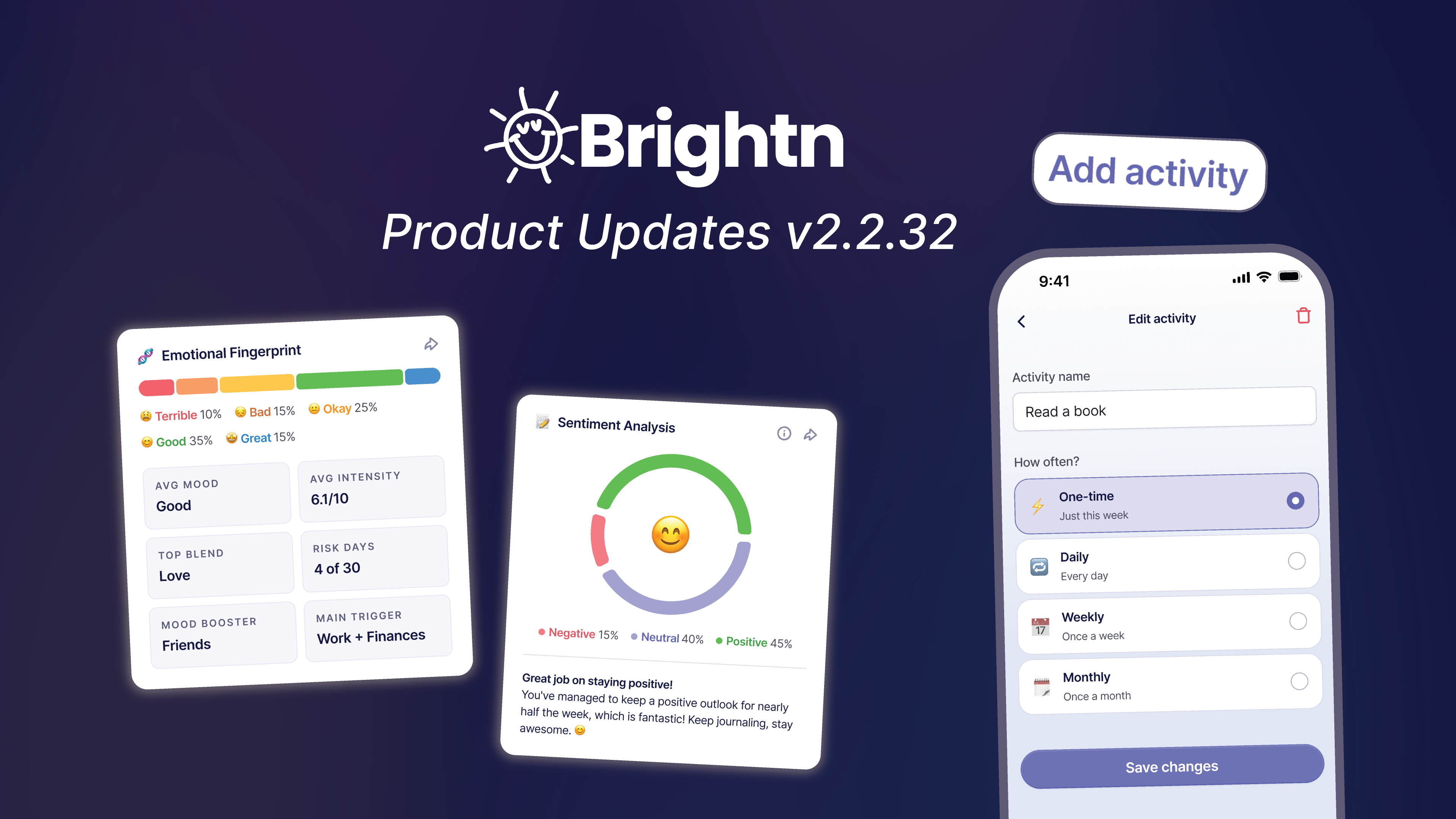
Personalized journaling with AI insights, daily mood tracking, and practical coping tools informed by established therapeutic frameworks. Available anytime, with no scheduling, waitlists, or session caps.
Licensed therapy when it is needed
Sessions with master's-level licensed clinicians from OpenLoop's credentialed network, booked and paid for inside the Brightn app, with therapist matching for continuity of care.
Crisis detection and resource routing
Brightn monitors for signs of acute distress during journaling and check-ins and routes users to the 988 Suicide and Crisis Lifeline, Crisis Text Line, and local resources, around the clock rather than only during business hours.
Because the daily layer reinforces therapeutic skills between appointments, each therapy session starts further along. Employers and benefit partners can access the same program as an integrated mental health benefit, with aggregate, de-identified reporting for their organizations.
Early Research Behind the Approach
Brightn's daily model has been evaluated in a controlled pilot study conducted by Dr. Richard Lopez at Worcester Polytechnic Institute. The study tested whether AI-powered journaling and mood tracking could support wellbeing during a major life transition. Compared to a control group, participants using Brightn reported:
- 36.1% reduction in depression symptoms (PHQ-9)
- 15.3% reduction in anxiety symptoms (GAD-7)
- 27.2% increase in social connection
- 79% of users reported a positive impact on their mental health, with 22 of 23 survey questions returning net positive sentiment
Adoption has followed a similar pattern in practice. In a six-month deployment through MedOne at a covered employer, 15% of eligible employees enrolled in Brightn, several times the utilization often reported for traditional employee assistance programs. Of those who enrolled, 93% used Brightn during the launch month, and approximately one in four remained active in a typical month, driven largely by journaling and AI-guided reflection. Uptake is the mechanism that makes preventive behavioral health work, and it has historically been the industry's hardest problem.
WPI pilot results are preliminary and should be interpreted as early directional signals rather than definitive clinical claims. A formal randomized controlled trial is underway at WPI this year.
What the Partners Are Saying
"This partnership allows us to extend care beyond the appointment and into daily life. OpenLoop has built the clinical infrastructure to deliver high-quality care at scale. By integrating with Brightn, we're enabling earlier identification of need and smoother access to care, so people get the right level of support at the right time."
Jon Lensing, CEO of OpenLoop
Brightn's platform is clinically-informed and designed to complement, not replace, therapy. It combines reflective journaling, emotional trend analysis, and practical resilience tools grounded in behavioral science to help users stay engaged and regulated between clinical encounters.
"Mental health doesn't happen once a week in a 50-minute session. It unfolds in everyday moments. This partnership with OpenLoop allows us to meet people earlier, recognize patterns sooner, and make the transition to clinical care feel supportive, not reactive."
Jeff Johnston, Founder and CEO of Brightn
Momentum Fueled by Proven Leadership
The partnership builds on Brightn's recent momentum, including the appointment of Dick Ferguson as Board Chair. Ferguson, a respected Iowa business leader and early investor in OpenLoop, brings deep healthcare, technology, and governance experience that strengthens alignment between the two organizations. His involvement underscores Brightn's growing position at the intersection of preventive behavioral health, clinical integration, and scalable healthcare partnerships.
A Forward-Looking Vision
Over the next three years, the OpenLoop and Brightn partnership is expected to:
- Expand upstream mental wellness access across employer, payer, and provider networks nationwide
- Enable earlier identification of emotional distress and smoother transitions to clinical care
- Support clinicians by reinforcing care plans between visits and improving adherence
- Help organizations shift spend from reactive crisis response to preventive, value-aligned behavioral health solutions
Together, OpenLoop and Brightn are building a model where mental health support is continuous, accessible, and responsive, long before someone reaches a breaking point.
About OpenLoop
OpenLoop is a national healthcare services organization providing clinicians, telehealth technology, and operational infrastructure to support high-quality medical and behavioral health care across all 50 states. With more than 16,000 clinicians across 35 specialties, OpenLoop maintains NCQA accreditation, full HIPAA compliance, and primary source credentialing verification for all providers. OpenLoop partners with innovative organizations to expand access, improve outcomes, and modernize care delivery. Learn more at www.openloophealth.com.
About Brightn
Brightn is an AI-powered upstream mental wellness platform that helps individuals and organizations move from reactive care to proactive support. Through clinically-informed design, reflective journaling, and early pattern recognition, Brightn strengthens emotional awareness and resilience while enabling seamless access to clinical care when needed. Built around the three pillars of Health, Wealth, and Purpose, Brightn serves individuals, employer groups, schools, PBMs, and healthcare organizations nationwide. Learn more at www.brightn.app.
Brightn's mission is simple: to Brightn lives by keeping people well long before crisis.
Follow us: @openloophealth / @brightnapp
###