Emilie Mauricio
July 28, 2026
•
6 min read

You already know mental health is a crisis.
You've seen the claims data. You've sat through the presentations. You've watched the graphs go up and to the right for three years running.
Nobody in that room is surprised anymore. And that's exactly the problem.
When everyone already knows how bad things are, another alarming statistic doesn't motivate. It paralyzes. Or worse — it becomes wallpaper. Something you nod at and move past because you've been nodding at it for years and still haven't found an answer that feels right.
There's a version of this conversation that happens in boardrooms and benefits meetings every year.
Someone pulls up a slide. Depression is up. Anxiety is up. Productivity is down. The cost per employee of untreated mental illness is staggering. Here's a graph. Here's another graph.
And the people in the room nod. Because they already know. You don't need to tell an HR director that mental health is expensive. You don't need to convince a CFO that it's getting worse. They're living with that reality every quarter.

Describing a problem people already feel doesn't create urgency. It creates fatigue.
Think about it this way: if it's 110 degrees outside, you don't need a weather report to know it's hot. What you need is someone to hand you a glass of water.
The data isn't useless. It's just been used wrong.
Instead of leading with how bad things are, read these four in sequence — and notice where they're pointing:
$17,000+
Employer health insurance costs projected per employee in 2026, rising 9.5% year over year.
Aon, September 2025
83%
Increase in mental health insurance claims between 2019 and 2023.
Behavioral Health Business, 2024
69%
Of all telehealth claim lines nationally are now mental health related.
FAIR Health, April 2024
55%+
Of mental health appointments are now conducted remotely.
Annals of Internal Medicine, 2024
That's not a list of problems. That's a map.
Costs are rising because claims are rising. Claims are rising because people are struggling. And when people struggle, they're already reaching for support through their phones — on their own schedule, without a waiting room, without a referral process.

Most employer mental health benefits are positioned for the moment after the crisis arrives.
A hotline you call when you can't cope. A therapy app you download when things fall apart. A directory you search after you've already decided you need professional help.
All of that is better than nothing. But it's all competing with the worst version of the person who needs it — the one with the least energy, the least patience, and the most friction standing between them and actual support.
Earlier doesn't mean more intensive. It means more ambient.
A mood check-in on a Tuesday. A journal entry that takes two minutes. A breathing exercise between back-to-back meetings. Small, low-stakes habits that keep someone connected to their own mental state — so when something hard shows up, they notice it sooner, and the path to support is already familiar.
The cost of getting this wrong is already visible. Employee engagement fell to just 21% in 2024 — only the second decline in the past 12 years. (Gallup, 2025) Disengagement and poor mental health travel together. Meeting people earlier in the cycle addresses both.
The employers who are going to come out ahead on mental health costs aren't the ones with the most accurate slide decks. They're the ones who stopped describing the problem and started meeting their people earlier.
Your employees already know things are hard. They don't need another graph.
Not a safety net for when things fall apart. A practice that's already in place when life starts to get heavy.
Because it will get heavy. It always does. The only variable is whether the support is already there.
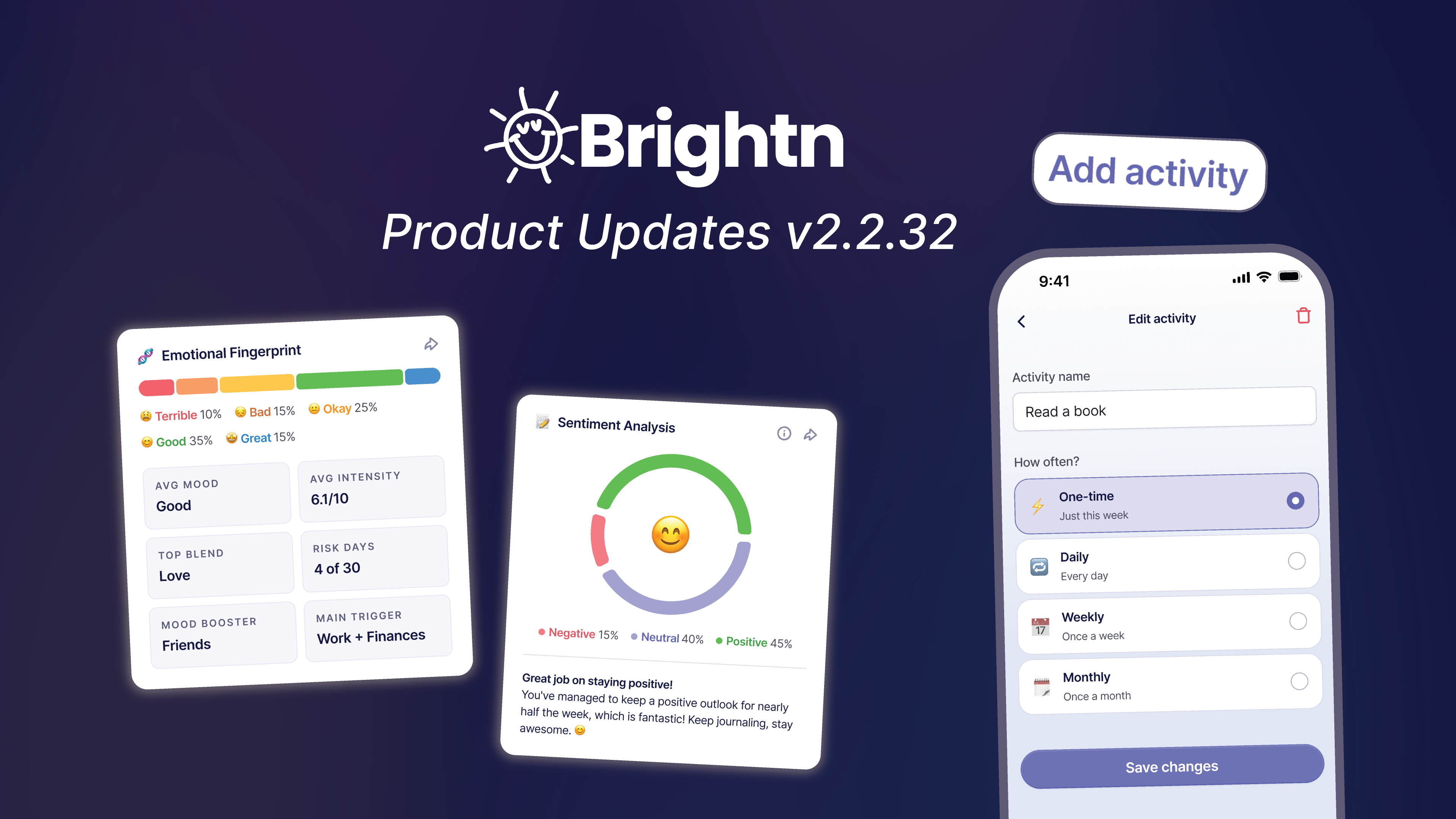
Brightn is a mental wellness app built for everyday life — mood tracking, journaling, guided exercises, and access to therapy when the moment calls for it. Designed to be part of the routine before anything goes wrong, so when something does, the support is already there.
Download Brightn below, or explore what Brightn does for employers.

Because awareness and action are different things. Most HR leaders and benefits decision-makers are already aware of the mental health crisis — they see it in claims data, absenteeism numbers, and exit interviews. What moves them to act isn't another alarming number. It's a clear, credible path from problem to solution that fits their budget and their employees' actual behavior.
Timing and friction. A benefit that's only designed for crisis moments will always struggle with utilization — because the people who need it most are the least equipped to navigate it when they're already overwhelmed. Benefits that live in the daily routine, before things get hard, have better uptake and measurably better outcomes.
Focus on direction, not fear. Show decision-makers where their employees are already going for mental health support — increasingly, their phones — and make the case that meeting them there proactively is both more humane and more cost-effective than waiting for the claim. Retention data and absenteeism numbers are often more persuasive to finance teams than clinical outcome statistics.
The WHO estimates that untreated depression and anxiety cost the global economy $1 trillion annually in lost productivity. Preventive care consistently outperforms reactive intervention on cost. The employers building the strongest case are tracking absenteeism, engagement scores, and retention alongside claims data — because the savings show up across all of them.
Look for something employees will actually open on a normal day — not just a hard one. Ask about daily engagement, not just sign-up numbers. Ask how easy it is to access a therapist from inside the tool. And ask whether the vendor is thinking about your population's mental health over time, not just during a crisis.