Emilie Mauricio
March 19, 2026
•
7 min read

You graduate. The job ends. The semester wraps up. Summer break begins. Retirement arrives. Suddenly, the role that defined your days—student, employee, professional—disappears, and you're left staring at a reflection you barely recognize.
"Who am I when I'm not doing something?"
If this question feels uncomfortably familiar, you're experiencing what psychologists call an identity crisis—a period of profound questioning about your sense of self, values, and purpose. While it might feel isolating, this transition is both common and deeply human. More importantly, it's an opportunity to discover who you are beyond the labels society has given you.
Modern culture trains us to answer "Who are you?" with "What do you do?" From childhood, we're praised for achievements, graded on performance, and measured by output. School becomes your identity. Your career becomes your worth. Your productivity becomes your proof of existence.
Research published in the
Journal of Personality and Social Psychology found that young adults who strongly tied their identity to external roles (student, athlete, employee) experienced significantly higher levels of anxiety and depression when those roles shifted or disappeared.
This isn't your fault. You've been socialized to measure your value by external markers:
When these external structures vanish, the question "Who am I?" becomes urgent and often terrifying. According to
Healthline, this type of identity crisis can occur at any age and during any major life transition—not just adolescence or midlife.

An identity crisis isn't always dramatic. It often shows up as a persistent, uncomfortable feeling that something fundamental has shifted. You might experience:
Research from
Medical News Today notes that identity confusion can lead to mental health challenges including depression and anxiety, but also emphasizes that questioning your identity is a normal—even necessary—part of growth.
When you strongly identify with a role—whether as a student, professional, athlete, or caregiver—losing that role can feel like losing yourself. Studies on
identity disruption in veterans reveal four common dimensions of this experience:
When your daily structure disappears, so does your sense of purpose. One study participant described it perfectly: "There is nothing in civilian life that will ever be as fulfilling or important as what I did in the military."
This feeling isn't limited to military transitions. Graduating students, retired professionals, and people leaving long-term careers all report similar emptiness when their defining purpose vanishes.
You might feel like your past achievements belong to a different person. The future feels foggy and directionless. The present feels like limbo.
This temporal disconnection makes it hard to see yourself as a continuous, coherent person evolving over time.

The roles that structured your relationships and daily activities suddenly don't exist. Who are you in social situations when you can't say "I'm a student at..." or "I work as..."? This loss of social positioning can feel destabilizing.
Without external validation, you might struggle to see your own value. As one study participant shared: "I feel so pathetic right now. I was a strong person...I had respect, I had a life, I had friends, I was good at what I did. I feel like a bottom feeder right now."
This shift from external to internal validation is painful but ultimately essential for authentic self-worth.
Start by recognizing the difference between what you do and who you are. Your job title, academic status, or productivity level are roles—they're not your essence.
Try this exercise: Write down all the roles you play (student, employee, friend, sibling, etc.). Now cross them all out and ask: "Who am I when I'm none of these things?" The answer might feel uncomfortable at first, but sitting with that discomfort is where growth begins.
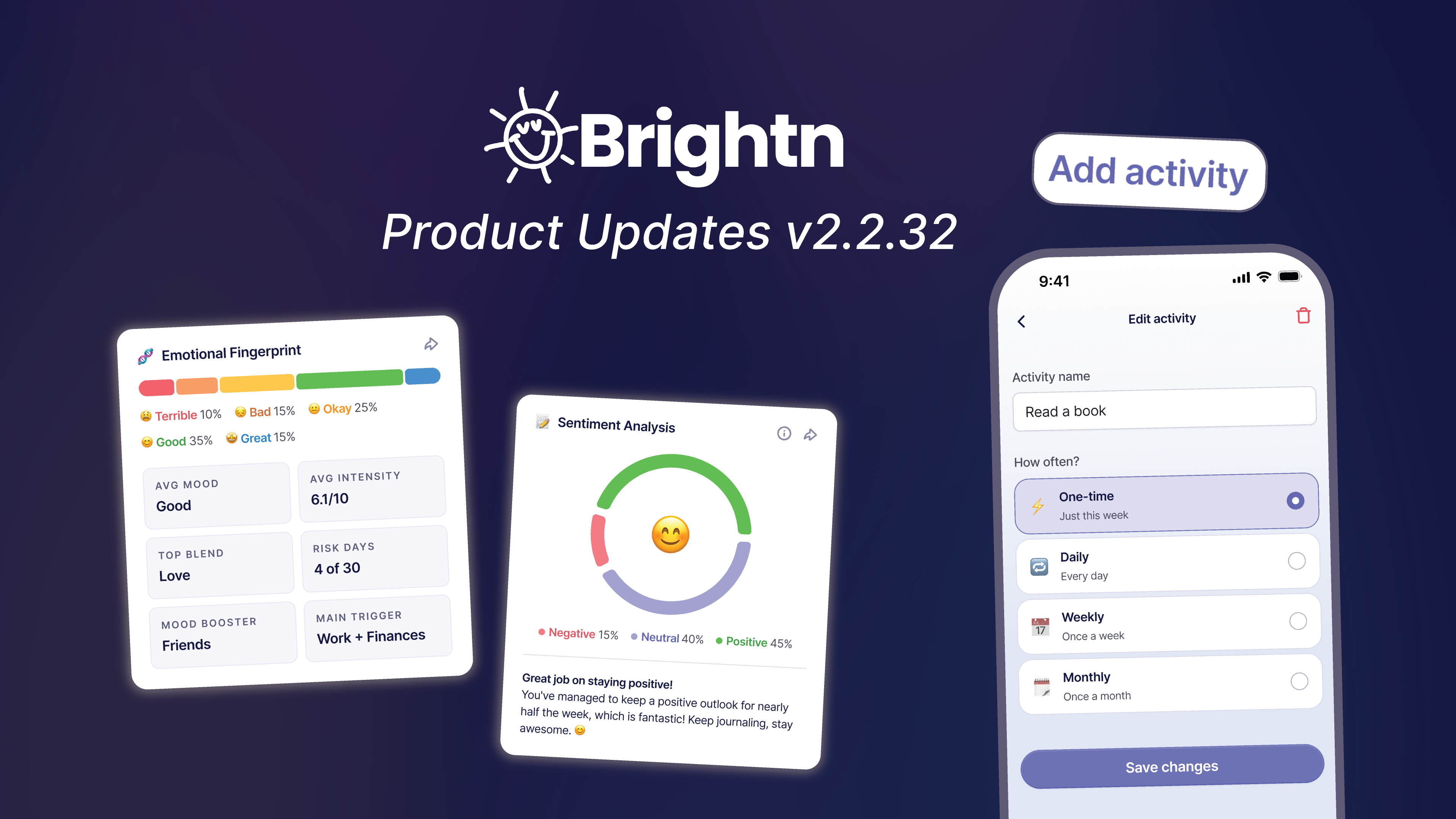
Brightn's guided journaling offers personalized prompts specifically designed to help you explore your core values and identity beyond external roles.
According to
BetterUp, exploring your values and beliefs is essential when navigating identity transitions. Your values—not your resume—define who you are.
Ask yourself:
Regular journaling about these questions reveals patterns that point toward your authentic self.

Developmental psychologist Erik Erikson, who coined the term "identity crisis," emphasized that these periods of questioning are not failures—they're necessary developmental stages.
Instead of rushing to fill the void with a new role, grant yourself permission to explore. Try new hobbies without pressure to excel. Have conversations about topics that intrigue you. Volunteer in areas that align with your values. Read widely. Take classes for curiosity rather than credentials.
This exploration phase isn't wasted time—it's identity research.
Shifting from external to internal validation requires deliberate practice. Research from
MindOwl shows that engaging in self-compassion practices and value-aligned activities strengthens internal self-worth.
Daily practices that build intrinsic worth:
Brightn's daily check-ins make it easy to track these practices and build consistent habits that support identity development beyond productivity.
What did you love doing before achievement and productivity dominated your life? What activities feel good simply because they bring you joy, peace, or fulfillment?
This might include:
These activities remind you that you exist and have value even when you're not producing, achieving, or being recognized.

Identity crises feel isolating because we rarely talk about them openly. Finding community with others experiencing similar transitions normalizes your experience and provides valuable perspective.
Research from
Charlie Health emphasizes that sharing struggles with trusted friends, family, or professionals provides emotional support and reduces feelings of isolation.
Consider:
Remember: seeking help is a sign of strength, not weakness.
Identity development isn't linear. You won't wake up one day with perfect clarity about who you are. Instead, you'll slowly piece together a more authentic understanding of yourself through experimentation, reflection, and time.
Be gentle with yourself during this process. Some days you'll feel confident and clear. Other days you'll feel lost and confused. Both are normal and necessary parts of the journey.
Your identity will continue evolving throughout your life—and that's not a bug, it's a feature of being human.
Navigating an identity crisis requires ongoing self-reflection, emotional support, and tools to track your growth.
Brightn's mental wellness app provides structured support for this deeply personal journey:
AI-powered journaling prompts designed specifically to explore values, purpose, and identity beyond productivity
Mood and emotional pattern tracking to understand how identity shifts affect your mental wellness
Daily check-ins that help you build intrinsic self-worth through consistent reflection
Goal-setting tools aligned with Brightn's three pillars—Health, Wealth, and Purpose—to build a multifaceted identity
Personalized insights that reveal patterns in how you think about yourself over time
Unlike generic wellness apps, Brightn understands that identity is complex and multidimensional—you're more than your job, your degree, or your productivity.

The transition from external validation to internal knowing is uncomfortable. It requires you to sit with uncertainty, question everything you thought defined you, and slowly rebuild a sense of self from the inside out.
But here's what awaits on the other side:
A deeper sense of who you are that doesn't crumble when circumstances change. Confidence that comes from knowing your values rather than your achievements. Freedom from the exhausting cycle of seeking external approval. Purpose that emerges from your authentic self rather than societal expectations.
You are not what you do. You are not your productivity. You are not the roles you play or the achievements you've accumulated.
You are the person experiencing all of it—the one asking these important questions, seeking deeper meaning, and courageously building an identity rooted in truth rather than performance.
Don't navigate this identity transition alone. Brightn gives you the tools, prompts, and support to discover who you are beyond the labels.
Download Brightn now and start your journey toward authentic self-understanding.
Whether you're graduating, changing careers, retiring, or simply questioning who you've become, Brightn's evidence-based approach to mental wellness meets you where you are and helps you become who you're meant to be.

For more mental wellness insights and identity exploration resources, visit