Emilie Mauricio
June 16, 2026
•
5 min read

Every January, gyms are packed. By March, the same equipment is empty again.
It's not that people stopped wanting to get healthy. It's that the gap between intending to go and actually going is enormous — and friction always wins.
The same dynamic is quietly destroying the ROI on mental health benefits at companies across the country. Most HR leaders and benefits brokers don't talk about it. The utilization reports sit in inboxes. And the problem compounds, year over year, while employees who need support never actually access it.

Employee Assistance Programs are offered by the overwhelming majority of large U.S. employers. On paper, they look like exactly what employees need: free counseling sessions, crisis hotlines, referral services. Comprehensive. Confidential. Available.
In practice, EAP utilization rates typically sit between 3% and 6%. For every 100 employees with access to an EAP benefit, roughly 95 of them never use it.
The journey from "I think I need support" to "I'm actually getting support through my EAP" requires a phone call to a number most employees can't remember, an intake assessment, a referral, a waiting period, and a first appointment. Every step in that sequence is a place where friction wins and the employee does nothing.
Gyms learned this lesson the hard way in the early 2000s. Peloton disrupted the industry not because it made better bikes, but because it eliminated the biggest friction point — getting there. When the barrier to showing up drops to zero, utilization climbs.
Mental health benefits haven't had that reckoning yet. But it's coming.
The scale of the problem makes the low utilization rates even more striking.
For employer health plan decision makers
The cost is documented. The ROI is documented. The delivery is where most plans break down.
Global productivity loss
$1T
Lost every year to depression and anxiety in the global workforce.
Source: World Health Organization, Mental Health at Work, 2024
Average EAP utilization
4%
The benefit most employers count on. Most employees never touch it.
Source: SHRM & National Business Group on Health
U.S. workforce impact
76%
of U.S. workers report at least one symptom of a mental health condition.
Source: Mind Share Partners, Mental Health at Work Report, 2023
Annual cost per employee
$15K
Estimated yearly cost of an employee with unaddressed depression in absenteeism and presenteeism.
Source: Tufts Medical Center / One Mind at Work
Return on every $1 invested
$4
Returned in improved productivity and reduced healthcare costs for every $1 invested in mental health support.
Source: WHO & Lancet Psychiatry, 2016
The retention factor
Employees who feel mentally supported at work are significantly more likely to stay, perform, and recommend their employer.
Source: American Psychological Association, Work and Well-Being Survey
According to the World Health Organization, depression and anxiety disorders cost the global economy an estimated $1 trillion per year in lost productivity. In the United States alone, untreated mental health conditions are among the leading contributors to absenteeism, presenteeism, and voluntary turnover.
The American Psychological Association's Work and Well-Being Survey consistently finds that employees who feel their mental health is supported at work are significantly more likely to stay, perform, and recommend their employer to others.
The math is not subtle. The ROI on effective mental health support is real. The problem isn't the investment — it's the delivery mechanism.
Here's the insight that changes how smart HR leaders think about this: motivation is the worst predictor of whether someone actually uses a benefit.
When employees learn their company offers mental health support, they're motivated. When they need to take five steps to access it, most of them don't. The research on behavior change is consistent: reducing friction matters far more than increasing motivation. It's why automatic enrollment dramatically outperforms opt-in retirement savings programs. It's why medication adherence improves with pill organizers rather than willpower campaigns.
Mental health support is no different. The tool has to meet people where they are — in their daily routine, before the crisis, with zero barrier to entry.
This is the shift from reactive to proactive that most organizations haven't made yet. And it's exactly where the gym membership analogy breaks down: the gym waits for you to show up. The best mental health tools are already there.
Brightn was built on a fundamentally different premise than an EAP.
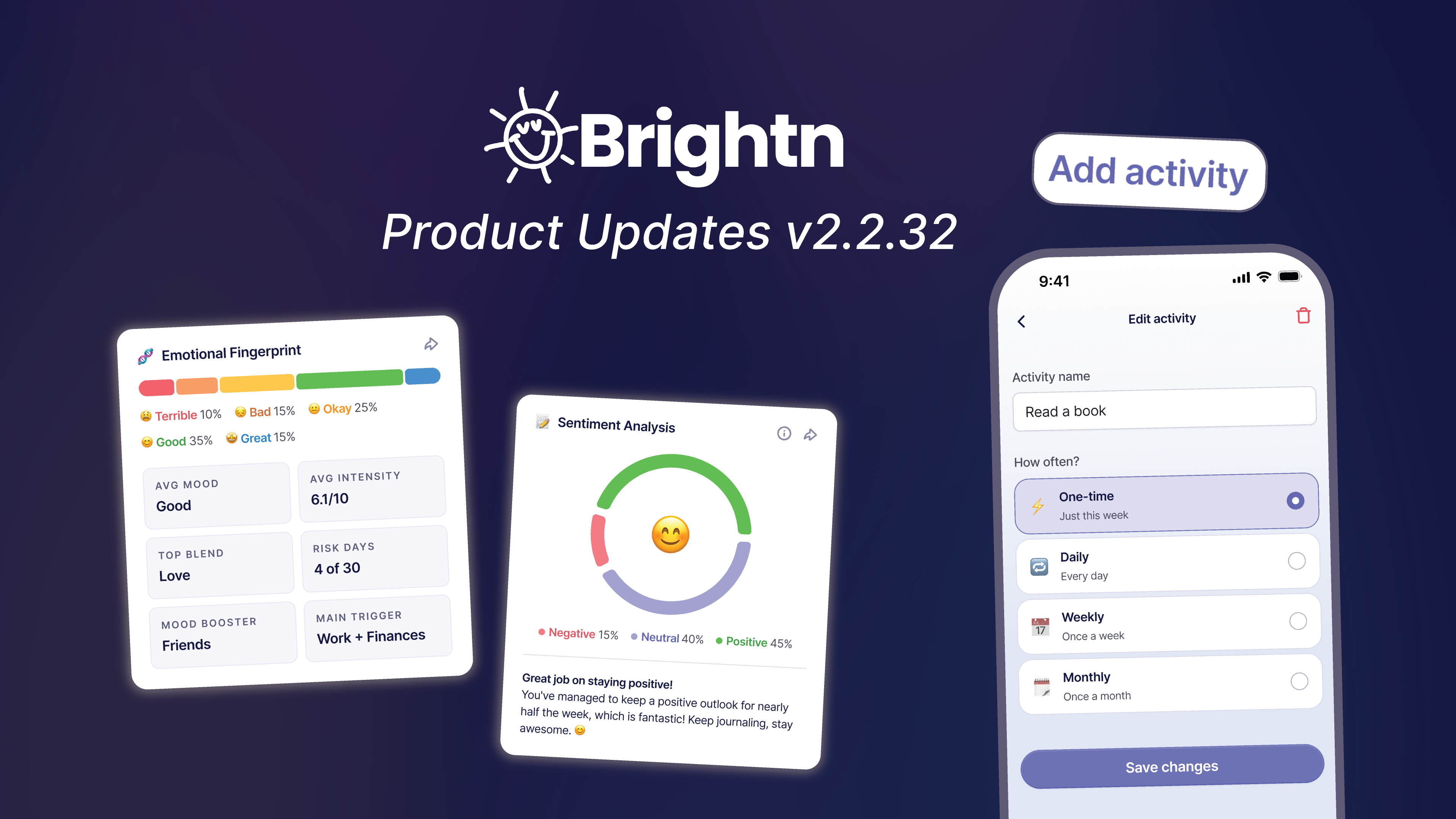
Instead of a reactive resource employees call when they're already struggling, it's a daily practice — AI-powered journaling that learns how you think, mood tracking that surfaces patterns over time, and personalized weekly reflections that build on each other. The app is designed to be part of a routine, not a crisis intervention.
The outcome of that design philosophy is measurable. A randomized pilot study at Worcester Polytechnic Institute, led by psychology professor Richard Lopez, found that students who used Brightn as part of a structured wellness program saw:
15% decrease in anxiety symptoms
36% decrease in depression symptoms
27% increase in social connection
Those results don't come from availability. They come from engagement. When the friction drops — when the tool is something people use daily rather than something they call in an emergency — outcomes follow.
That's what distinguishes a gym membership from a Peloton. And it's what distinguishes Brightn from a traditional EAP.
Benefits brokers who are ahead of the curve aren't waiting for next year's utilization report.
They're asking their clients a different question: not "what mental health benefits do we offer?" but "what mental health benefits are our employees actually using?" That shift in framing changes everything about the product conversation that follows.
When you start from utilization — from real engagement data — tools like Brightn rise to the top. They're designed for daily use, personalized from the first session, and available on the device employees already carry everywhere. No intake call. No referral. No waiting period.
For brokers, that also means a simpler, more defensible recommendation to bring to skeptical clients. The question isn't "is this better than nothing?" The question is "is this better than a benefit 96% of your workforce will never touch?"
The answer tends to close itself.
Low EAP utilization isn't a workforce engagement problem. It's the gym membership problem — a structural design failure that's been normalized because it's so common.
The companies and brokers solving it aren't doing anything complicated. They're choosing tools built for daily engagement rather than crisis response, and watching the utilization numbers — and the outcomes — shift accordingly.
If you want to see what that looks like in practice, the app is the fastest way to understand it — use it for a week and the utilization argument makes itself. Bringing Brightn to your organization or client base? Visit our about page to learn more and get in touch.