Tyce Hoskins
June 16, 2026
•
3 min read
Watch the full webinar here:
How daily support, reflection, and prevention can help students before crisis
Students don’t always struggle loudly.
Many are not in crisis. They are not raising their hand. They may not be walking into a counselor’s office. But they are stressed, disconnected, overwhelmed, and trying to make it through the day.
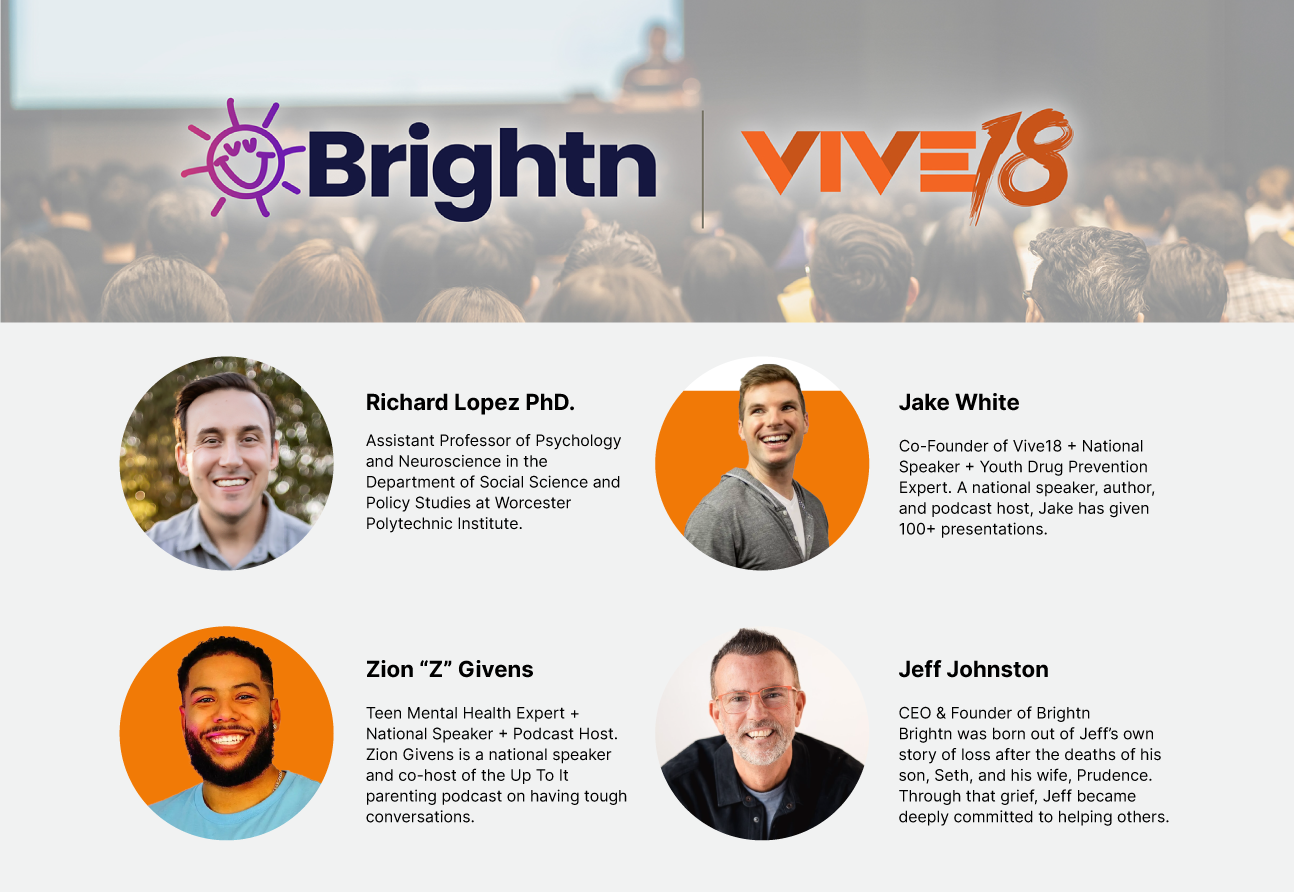
That was the focus of Brightn and Vive18’s recent webinar, where Jeff Johnston, Founder and CEO of Brightn, joined Jake White, Co-Founder of Vive18, and Dr. Richard Lopez, Assistant Professor of Psychology and Neuroscience at Worcester Polytechnic Institute, to discuss student mental health, prevention, and the early results from a WPI pilot study using Brightn.
The conversation centered on one key idea: schools need support that reaches students earlier.
Jeff opened the webinar by sharing the personal story behind Brightn. After losing his son Seth to fentanyl and later losing his wife Prudence after her struggle with addiction, prescription pills, and mental health, Jeff became focused on one question:
How do we stop only pulling people out of the river and start asking why they are falling in?
That prevention-first mindset became the foundation for Brightn.
Rather than waiting until students hit a breaking point, Brightn was built to support reflection, emotional awareness, habit-building, and daily wellness in the moments where mental health actually lives: late at night, between classes, after a hard day, or when a student is not ready to talk to someone yet.
Dr. Lopez shared early results from a WPI pilot study with first-year college students. The study looked at students using Brightn alongside a values-based reflection approach during a major life transition: the first semester of college.
The results were encouraging.
Students using Brightn saw:
15.3% reduction in anxiety symptoms vs. control
36.1% reduction in depression symptoms vs. control
27.2% increase in social connection
Dr. Lopez also noted that students using Brightn maintained more stable sleep patterns compared to the active control group, where sleep declined during the early weeks of the semester.
For schools, the takeaway is important: even small moments of reflection can help students feel more connected, more aware of their patterns, and more supported during stressful transitions.
One of the strongest themes from the webinar was that students are hungry for reflection, but often do not have enough structured opportunities to pause.
Dr. Lopez explained that even a few minutes of daily journaling can help students get thoughts out of their heads, notice patterns, and better understand what they are feeling. Student feedback from the pilot reflected this. Students described journaling as helpful for processing emotions, building self-awareness, improving study habits, and developing more social confidence.
Brightn is not positioned as a replacement for therapy, counselors, or human connection. It is designed to be a daily support layer that helps students reflect between those human touchpoints and, when needed, move toward additional support.
The Q&A focused on the questions school leaders and prevention professionals care about most: safety, age range, implementation, and privacy.
On safety, the team discussed how Brightn is designed to avoid blindly affirming harmful thoughts or unsafe language. Instead, concerning language can trigger appropriate escalation pathways, including crisis resources like 988 when needed.
On age range, the team shared that Brightn is currently most aligned with students 13 and older, with additional considerations for younger students and parental guidance.
On implementation, the conversation explored how Brightn can be woven into existing school routines, such as homeroom check-ins, advisory periods, restorative practices, prevention programming, or student support workflows.
On privacy, the team explained that schools receive high-level insights and flags rather than direct access to private journal entries, helping protect student trust while still allowing staff to identify when support may be needed.
Student mental health support cannot only happen after a crisis.
Schools are already stretched. Counselors are carrying heavy caseloads. Prevention teams are asked to do more with less. Students need tools that meet them earlier, more often, and in ways that feel accessible.
The webinar made one thing clear: daily support does not replace human care. It helps extend it.
Brightn and Vive18 are working together to help schools move upstream, giving students more ways to build resilience, reflect on what they are feeling, and feel less alone before they reach a breaking point.
Want to learn how Brightn could support your school or student community?