Emilie Mauricio
June 16, 2026
•
4 min read

You have a financial plan. A retirement strategy. Maybe a meal plan, a workout schedule, a vacation itinerary already booked for August.
Most people plan obsessively for almost everything — except their mental health.
And it's not because mental health doesn't matter to them. Ask almost anyone whether they want to feel less anxious, more focused, more connected to the people around them, and the answer is obvious. The problem isn't desire. The problem is that mental health is the one area of life where most people operate entirely without a plan — reacting to crises instead of building something sustainable before one arrives.
That gap is expensive. For individuals, it costs years of unnecessary suffering before anyone gets real support. For organizations, it shows up in absenteeism rates, turnover, and the slow erosion of a team that used to run well.
There's a better approach. It starts with asking a question most people have never been asked: what's your mental health plan?

Think about how much infrastructure exists to help people plan things that matter to them.
Financial planning has an entire industry built around it — advisors, apps, robo-investors, retirement calculators. Physical health has annual checkups, preventive screenings, and gym memberships (even if they go unused). Nutrition has meal planning services, dietitians, and an app for every dietary philosophy imaginable.
That's not an exaggeration. For most people — and most organizations — the mental health "plan" is essentially: feel fine until you don't, then try to find help. The system is built almost entirely around intervention after the fact, not investment before the fact.
The World Health Organization estimates that depression and anxiety cost the global economy $1 trillion annually in lost productivity. A meaningful portion of that figure represents people who needed support long before they reached the point where their performance suffered — but never got it because nothing in their life was prompting them to build a proactive mental health practice.
That's the planning gap in action.
A mental health plan isn't therapy, though therapy can be part of one. It's not medication, though that might be appropriate for some people too. It's not a crisis protocol, a hotline number, or a wellness stipend you forget to use.
A mental health plan is the set of daily, weekly, and monthly practices that help you understand how you're doing — and give you somewhere to go before things get hard.
At its core, it usually includes a few things:
Most people have almost no awareness of their own emotional patterns. They know when they're having a bad week, but they couldn't tell you whether this month has been harder than last month, what triggers tend to cluster together, or what consistently helps them recover. Without data on yourself, you're flying blind.
One of the clearest findings in mental health research is that avoidance makes things worse over time. Studies published in journals like Emotion consistently show that people who regularly process and label their emotional experiences have better psychological outcomes than those who don't. That processing looks different for different people — journaling, reflection, conversation — but the common thread is that it happens regularly, not just in moments of crisis.
The most resilient people aren't the ones who never struggle. They're the ones who know how to find their way back to okay. That requires having a clear enough sense of what "okay" looks like for them that they can notice when they've drifted from it and move back toward it intentionally.
None of that is complicated. But it doesn't happen by accident either. It happens because someone built it into their life before they needed it.

For HR leaders, the organizational version of the planning gap is equally costly.
Most corporate mental health strategies are reactive by design: offer an EAP, provide a mental health day policy, and wait for employees to come forward when they're struggling. The problem is that the employees most in need of support are typically the least likely to self-identify — partly because of stigma, partly because by the time the struggle is visible, the capacity to seek help is already depleted.
Research from the American Psychological Association shows that employees who feel their mental health is proactively supported at work — not just available to them in a crisis — report significantly higher levels of engagement, trust in leadership, and intention to stay with their employer.
The shift from reactive to proactive isn't just better for employees. It's better for the business.
And it doesn't require overhauling a benefits package. It requires choosing tools that build daily practice rather than waiting for crisis — the same logic that separates a financial planner from a bankruptcy attorney.
The good news is that the infrastructure for a real mental health plan now exists in a way it simply didn't ten years ago.
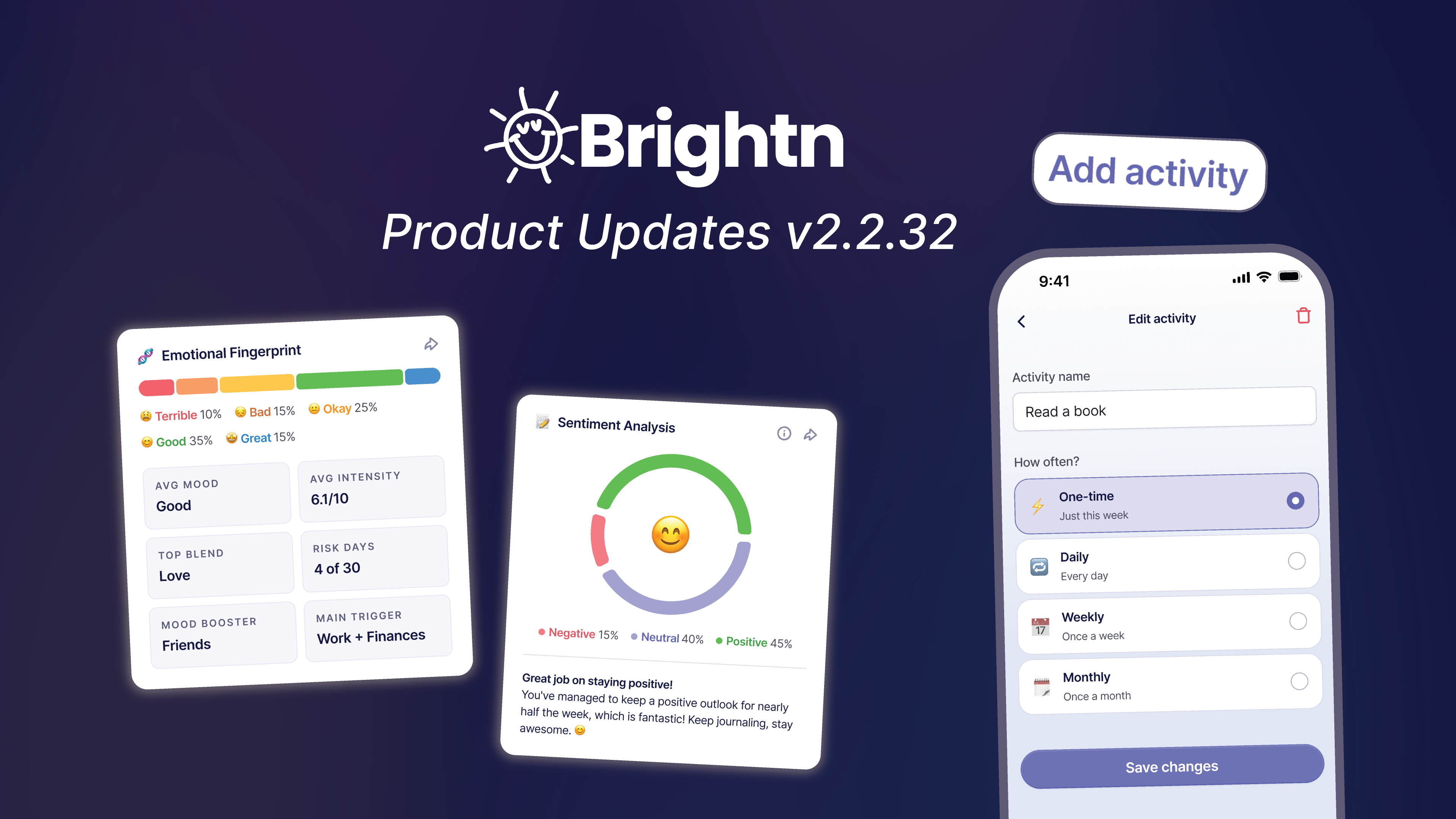
Brightn is built specifically for this — not as a crisis intervention tool, but as a daily mental wellness practice. AI-powered journaling that learns your patterns over time. Mood tracking that surfaces what you wouldn't otherwise notice. Weekly check-ins that keep you connected to how you're actually doing, not just how you think you're doing.
The outcomes from consistent, proactive use are measurable. In a randomized pilot study conducted by Professor Richard Lopez, an assistant professor of psychology and neuroscience at Worcester Polytechnic Institute, first-year college students who used Brightn as part of a structured values-based wellness program saw:
15% decrease in anxiety symptoms
36% decrease in depression symptoms
27% increase in social connection
Not because they were in crisis and got help — but because they built a practice before they needed one.
That's what a mental health plan looks like in action.
The best time to build a mental health plan is before anything is wrong. Before the quarter gets hard, before the relationship frays, before the job gets overwhelming. Not because something bad is coming — but because the people and organizations with a foundation in place handle hard things better when they do.
You plan your finances before the market drops. You build your physical health before you get sick. The same logic applies here.
If you're an HR leader thinking about what proactive mental health support looks like at scale, visit Brightn's about page — there's a lot there, from the team to the research to ways to connect. And if you want to understand the product from the inside, the app is the best first step.