Emilie Mauricio
January 15, 2026
•
9 min read
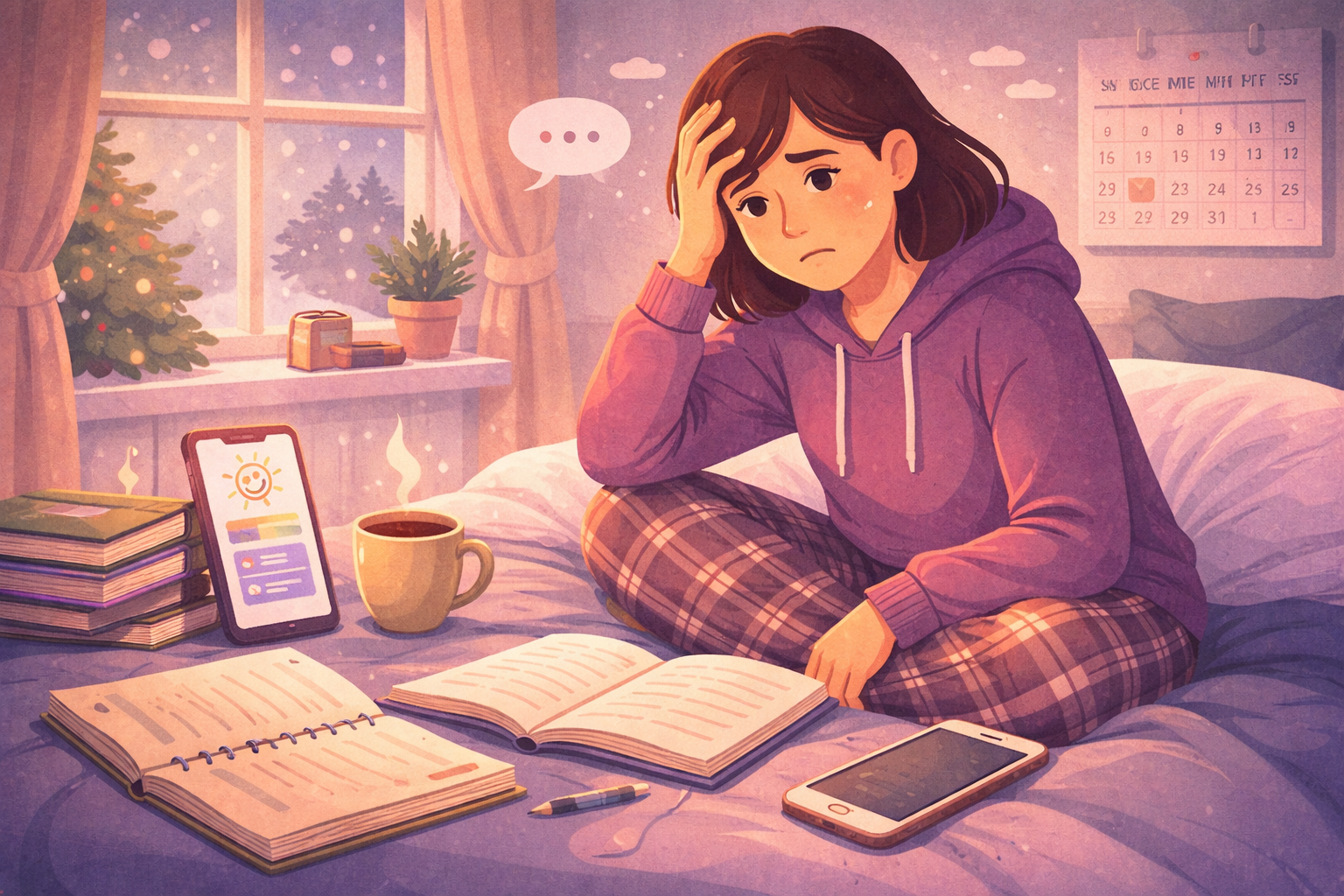
You've survived finals week. The semester is officially over. You have weeks of unstructured time stretching ahead of you – no deadlines, no lectures, no group projects. This should feel like paradise, right?
So why do nearly 75% of college students report feeling overwhelmed or anxious during breaks – the very time meant for recovery?
The Quick Answer: This phenomenon – struggling to rest when you finally have the time – isn't laziness or ingratitude. It's a psychological pattern that reveals how our brains actually process rest, structure, and self-worth. Understanding why winter break feels so paradoxically difficult is the first step toward actually using it to recover.
During the semester, your nervous system runs on overdrive. You're juggling classes, assignments, social obligations, maybe a part-time job, and trying to maintain some semblance of a healthy routine. Your brain adapts by staying in a constant state of activation – what psychologists call "hyperarousal." Your baseline becomes stress.
Then winter break arrives, and suddenly that external pressure evaporates. But here's the catch: your nervous system doesn't switch off like a light. Research from the American Psychological Association shows that chronic stress fundamentally changes how our bodies respond to downtime. When students trained in crisis mode suddenly have nothing to crisis-manage, they often experience what's called a "let-down effect" – where illness, anxiety, or emotional crashes emerge precisely when the pressure lifts.
Your body was running on cortisol and adrenaline for months. When those chemicals finally drop, the crash feels disorienting. You're not broken – you're experiencing the biological aftermath of sustained stress.

Quick Takeaways:
The struggle to rest during break isn't a personal failing. It's the predictable result of how we've been conditioned to operate. Here's what's really happening beneath the surface:
Important to remember: This isn't a sign that break is making you worse – it's evidence that you finally have the psychological space to acknowledge what's been there all along. Your mind is doing essential maintenance work, even if it feels uncomfortable. Learn more about emotional processing and how to support it.

Rest isn't passive – it's an active skill that requires intentionality, especially when your nervous system has been trained for constant activation. Here's how to design a break that actually restores you:
The winter break paradox reveals something essential about modern life: we've become so conditioned to constant productivity that we've forgotten how to simply be. Rest feels uncomfortable because it requires you to release control, sit with yourself, and trust that your worth isn't contingent on output.
But here's the truth: learning to rest is just as important as learning to work. Your capacity for focus, creativity, and resilience during the spring semester depends entirely on whether you allow yourself genuine recovery now. Research on student burnout confirms that adequate rest periods are essential for academic performance and mental health. Rest isn't lazy. It's strategic. It's necessary. And it's a skill that will serve you far beyond college.
The more you practice resting in alignment with your nervous system – rather than against it – the more sustainable your success becomes.

At Brightn, we understand that rest isn't one-size-fits-all. What recharges one person might drain another. That's why our approach to mental wellness is built around self-awareness, flexibility, and sustainable practices that work with your psychology – not against it.
Here's how Brightn helps you navigate winter break (and life beyond it):
Brightn's AI-powered journaling helps you notice what actually restores you versus what just fills time. During break, you can:
When you understand your internal landscape, you can design a break that actually works for you.
Use Brightn's customizable Weekly Planner to create gentle structure without sacrificing freedom. Set reminders for:
With Brightn, structure supports rest – it doesn't compete with it.
Break often amplifies unprocessed feelings. Brightn's guided prompts and breathwork tools help you:
By building emotional awareness now, you develop skills that carry into every semester ahead.
Using your Brightn Zone and Unique Life Statement, you can explore:
When your rest reflects your true identity, it stops feeling like wasted time.
Track your energy. Build sustainable routines. Learn to rest without apology. Download Brightn and turn winter break into the reset you actually need.

Because our culture equates worth with productivity. From childhood, you've been conditioned to measure your value through achievement. When break removes that metric, your brain panics. But rest is productive – it's how your nervous system repairs, how creativity replenishes, and how burnout is prevented. Reframing rest as essential maintenance, not laziness, is the first step toward releasing the guilt.
Absolutely. Structure provides psychological safety, and break removes that anchor. Additionally, suppressed emotions from the semester often surface when you finally have space to feel them. This doesn't mean break is bad for you – it means your mind is finally processing what you didn't have time for before. Use tools like Brightn's mood tracking to build awareness around these patterns.
It varies by person, but research suggests it takes at least 3-7 days for your nervous system to begin downregulating from chronic stress. If you've been running on empty all semester, full recovery might take two weeks or more. Be patient with the process – rest isn't instant, and the first few days of break often feel the hardest.
Your brain is stuck in planning mode because that's been your survival strategy for months. Try setting aside 15 minutes each day for "productive worry" – where you intentionally think about spring semester, make lists, or plan ahead. This technique, rooted in cognitive behavioral therapy, helps contain anxiety rather than letting it consume your entire day. Outside that window, practice redirecting your attention to the present. Journaling with Brightn's AI tools can help you externalize those thoughts so they stop looping endlessly in your head.
Going home for break can reintroduce old dynamics that feel draining. Setting healthy boundaries is essential: protect your sleep schedule, carve out alone time for self-care, and be honest about your capacity for family obligations. Use Brightn to check in with yourself daily – even 10 minutes of intentional self-reflection can create an internal anchor when your external environment feels unstable. Remember: rest doesn't require perfect conditions. It requires self-awareness and small, protective choices.

Related Articles
The Power of Self-Care: tips for taking care of your mental health: Self-care isn't indulgent – it's the foundation for sustainable mental health. This article offers science-backed strategies for sleep, movement, boundaries, and mindfulness that help you build resilience during high-stress periods and recover effectively during breaks.
Financial Wellness: How Money Impacts Mental Health: Winter break often amplifies financial stress for students. This article explores how money worries affect your emotional wellbeing and offers practical tools for building financial clarity without burnout – helping you enjoy your time off without constant financial anxiety.
Why Budgeting Feels like Dieting (and Fails the Same Way): Just like rest, budgeting fails when it ignores your psychology. This article breaks down why restrictive systems backfire and how to build financial (and mental) wellness practices that actually stick long-term.
American Psychological Association (2022) Supporting students' mental health is a growing challenge for college campuses, Monitor on Psychology. Available at: https://www.apa.org/monitor/2022/10/mental-health-campus-care (Accessed: 19 November 2024).
Harvard Health Publishing (2020) Understanding the stress response, Harvard Medical School. Available at: https://www.health.harvard.edu/staying-healthy/understanding-the-stress-response (Accessed: 19 November 2024).
McLean Hospital (2022) The social dilemma: Social media and your mental health, McLean Hospital. Available at: https://www.mcleanhospital.org/essential/it-or-not-social-medias-affecting-your-mental-health (Accessed: 19 November 2024).
National Sleep Foundation (2024) Mental health and sleep, Sleep Foundation. Available at: https://www.sleepfoundation.org/mental-health (Accessed: 19 November 2024).
NICABM (2021) How to help your clients understand their window of tolerance, National Institute for the Clinical Application of Behavioral Medicine. Available at: https://www.nicabm.com/trauma-how-to-help-your-clients-understand-their-window-of-tolerance/ (Accessed: 19 November 2024).
Mindful Communications (2024) Mindfulness meditation: Getting started, Mindful. Available at: https://www.mindful.org/meditation/mindfulness-getting-started/ (Accessed: 19 November 2024).
American Psychological Association (2024) Cognitive behavioral therapy, APA. Available at: https://www.apa.org/ptsd-guideline/patients-and-families/cognitive-behavioral (Accessed: 19 November 2024).
Psychology Today (2024) Setting boundaries, Psychology Today. Available at: https://www.psychologytoday.com/us/basics/boundaries (Accessed: 19 November 2024).
Ayala, E.E., et al. (2022) 'Prevalence, perceptions, and consequences of COVID-19 on medical student burnout', BMC Medical Education, 22(1). Available at: https://www.ncbi.nlm.nih.gov/pmc/articles/PMC8783635/ (Accessed: 19 November 2024).
American Psychological Association (2023) Stress effects on the body, American Psychological Association. Available at: https://www.apa.org/topics/stress/body (Accessed: 19 November 2024).
American Psychological Association (2022) Burnout and stress are everywhere, Monitor on Psychology. Available at: https://www.apa.org/monitor/2022/01/special-burnout-stress (Accessed: 19 November 2024).
Meerlo, P., Havekes, R. and Steiger, A. (2015) 'Chronically restricted or disrupted sleep as a causal factor in the development of depression', Current Topics in Behavioral Neurosciences, 25, pp. 459–481. Available at: https://www.ncbi.nlm.nih.gov/pmc/articles/PMC5476783/ (Accessed: 19 November 2024).
Muraven, M. and Baumeister, R.F. (2000) 'Self-regulation and depletion of limited resources: Does self-control resemble a muscle?', Psychological Bulletin, 126(2), pp. 247–259.
Pfeffer, I. (2020) 'The role of routine in the mental health of older adults during the COVID-19 pandemic', National Center for Biotechnology Information. Available at: https://www.ncbi.nlm.nih.gov/pmc/articles/PMC7434239/ (Accessed: 19 November 2024).
Leisure (2024) ScienceDirect Topics. Available at: https://www.sciencedirect.com/topics/psychology/leisure (Accessed: 19 November 2024).