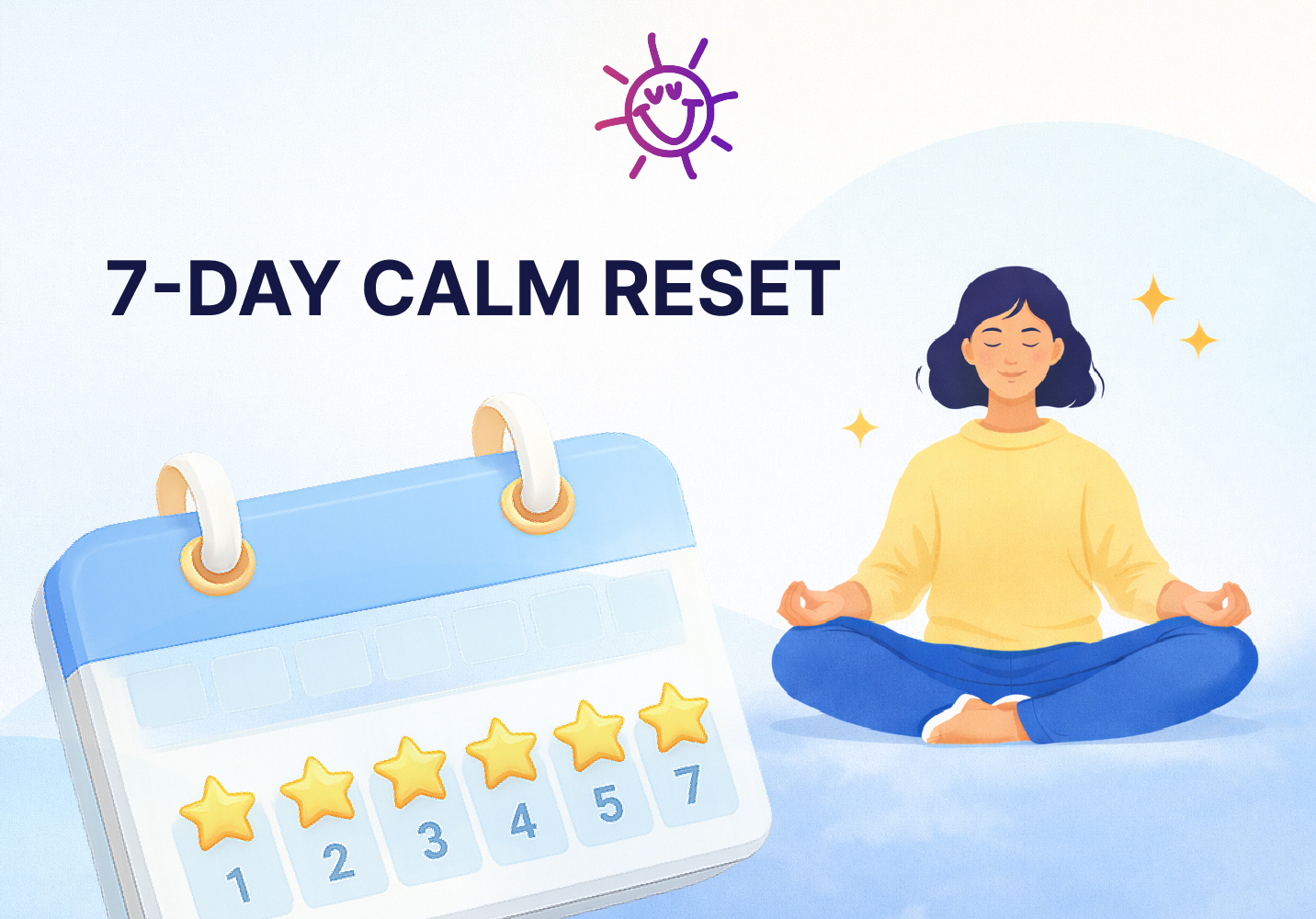
The Brightn 7-Day Calm Reset
How to Sit With Yourself for 15 Minutes Without Spiraling
5 to 15 minutes a day. No experience required. Your mind wandering is the workout.
You know that moment when you finally sit down, everything gets quiet, and your brain immediately goes loud? The spiral starts. The to-do list replays. You reach for your phone before you even realize you're doing it.
You're not broken. You're just out of practice.
This 7-day reset is designed to help you build a small, daily stillness habit — starting at just 2 minutes. By Day 7, the goal is simple: sit with yourself for 15 minutes without panicking, spiraling, or needing a distraction. No perfection required. No special equipment. Just you, a timer, and a willingness to try.
· · ·
Before You Start
Three quick setup steps that make this dramatically easier to stick with:
- Pick your time and place. Same spot, same time each day. Consistency removes the decision fatigue of "when should I do this?"
- Put your phone out of reach. Ideally another room. If it's within arm's length, your brain will find a reason to grab it.
- Make an if–then plan. Write this down: "If it's [time] and I'm in [place], then I do my Calm Reset." Implementation intentions like this make habits significantly more likely to stick.
Set a Daily Reminder
This is non-negotiable if you want to actually follow through for seven days. Pick one:
- Phone alarm — set for your chosen time with a label like "Calm Reset – 2 min today"
- Calendar event — blocked as a recurring 15-minute window for the next 7 days
- Brightn app — set up a daily habit reminder so your check-in and your Calm Reset live in the same place
The reminder matters more than the method. Choose whichever one you'll actually see and act on.
A Note on Safety
If stillness spikes your anxiety, brings up trauma, or feels overwhelming: keep your eyes open, shorten the time, or switch to a walking version. Mindfulness practices are usually low-risk, but they can feel activating for some people. Go at your pace. There's no wrong way to start small.
· · ·
Day 1
Make Stillness Small
Today's sit: 2 minutes
That's it. Two minutes. You're not meditating. You're just practicing being still.
What to Do
- Sit down. Feet flat on the floor. Eyes open or softly closed.
- Breathe normally. Don't try to control it.
- Pick an anchor: quietly notice the feeling of your feet on the ground, or the rhythm of your breath.
- When your mind wanders (it will), gently come back to the anchor. That's the entire practice.
Micro-Moment (Real Life)
Next time you're waiting — microwave, elevator, checkout line — take 3 slow breaths before you touch your phone. This is where the habit starts leaking into your real day.
Journal Prompt
"What am I trying not to feel right now?"
Day 2
Name It to Calm It
Today's sit: 3 minutes
What to Do
- First 30 seconds: just breathe.
- Then label what's happening like a weather report: "I'm noticing anxiety." "I'm noticing restlessness." "I'm noticing boredom."
Why this works: Putting feelings into words can reduce the brain's threat response and emotional reactivity. You're not fixing the feeling. You're just acknowledging it — and that alone takes some of the charge out of it.
Micro-Moment
When you reach for your phone on autopilot, pause and label first: "I'm noticing the urge to distract."
Journal Prompt
"If this feeling had a message, it would be: ____"
Day 3
Thoughts Are Not Instructions
Today's sit: 5 minutes
What to Do
- Every time a thought shows up, add one phrase before it: "I'm having the thought that ____."
- Then return to your anchor (breath or feet).
This creates space between you and the thought. Instead of getting dragged into the story, you're watching it pass. That distance is the whole point.
Micro-Moment
Pick one common trigger moment (waiting for something, standing in line). Before you open any app, do 10 seconds of "I'm having the thought that…"
Journal Prompt
"What thought keeps showing up when it gets quiet?"
Day 4
Stillness, But Moving
Today's practice: 7-minute mindful walk (no phone)
If sitting still feels impossible, this day is for you.
What to Do
- Walk slowly. Leave the earbuds out.
- Feel the soles of your feet with each step.
- Notice 5 things you see, 4 things you hear, and 3 things you physically feel.
Research shows mindfulness-based practices like simple attention exercises can improve psychological wellbeing in many everyday settings. You don't need a cushion or a candle. A sidewalk works fine.
Micro-Moment
Walking from your car to a building? Phone stays in your pocket. Notice your steps, the air, the sounds around you.
Journal Prompt
"What changed in my body when I stopped multitasking?"
Day 5
Unload Your Mind
Today's sit: 8 minutes + 2 minutes of writing
What to Do
- Sit for 8 minutes using any technique from the previous days (anchor, labeling, or "I'm having the thought…").
- Then grab a pen or open your journal and write fast for 2 minutes. No grammar, no filters. Finish this sentence three times: "What I've been carrying is ____."
Expressive writing has been studied for decades and can help people process stress. It can also feel intense in the moment, so be gentle with yourself.
Micro-Moment
Before you check your phone at night, write one sentence: "Right now I feel ____."
Journal Prompt
"What do I actually need more of this week?"
Day 6
Train Your Nervous System
Today's sit: 12 minutes total
What to Do
- First 5 minutes — slow breathing: Inhale for 4 seconds, exhale for 6 seconds. Repeat.
- Next 7 minutes — normal breathing + noticing: Breathe naturally and just observe what's happening in your body and mind.
Research suggests slow, deep breathing can activate your parasympathetic nervous system and reduce anxiety levels. The longer exhale is the key — it signals safety to your brain.
Micro-Moment
Any time you're waiting today: one 4-in / 6-out breath. That's it. One breath can shift the moment.
Journal Prompt
"What does calm feel like in my body, even 1%?"
Day 7
The 15-Minute Reset
Today's sit: 15 minutes
You've built to this. Everything you've practiced this week comes together today.
What to Do
- Minutes 1–5: Breathe + anchor (feet or breath).
- Minutes 6–10: Label emotions ("Noticing…").
- Minutes 11–15: "I'm having the thought that…" + return to breath.
Build Your Stillness Plan
Pick 3 moments you usually scroll on autopilot and write an if–then for each:
- "If I'm waiting for the microwave, then I do 3 slow breaths."
- "If I'm in the elevator, then I feel my feet."
- "If I'm in line, then I label my emotion once."
This kind of if–then planning helps behaviors fire automatically when the moment happens. You're not relying on willpower. You're building a system.
Journal Prompt
"What's one quiet moment I can protect every day?"
· · ·
What Comes Next
Seven days doesn't fix everything. But it proves something important: you can do this.
Here's how to keep the momentum going:
- Keep your daily reminder active. Don't remove the alarm or calendar block. Let it keep showing up for you.
- Pick your favorite day and repeat it. You don't have to do all seven again. Find the one that clicked and make it your daily practice.
- Track the pattern, not the perfection. Brightn's mood tracking and habit tools can help you see what's building over time — even on the days it doesn't feel like progress.
- Use Brightn for your daily check-in. A quick mood check-in, a journaling prompt, and a simple weekly plan — so you're not doing this alone.
You don't need to have it all figured out. Start with one honest check-in.
Download Brightn & Build Your Plan