Emilie Mauricio
March 19, 2026
•
4 min read

That feeling when nothing is technically wrong, but everything feels heavy? When you're going through the motions but can't shake the sense that something's just... off? You're not imagining it, and you're definitely not alone.
Mental health doesn't break down in neat, diagnosable categories. Sometimes it just quietly slides into a gray zone where you're functioning but not thriving, present but not engaged, awake but not really alive. The good news? You don't need to wait for things to get worse before you hit reset.
Our brains are incredibly sensitive to subtle changes in our environment, relationships, routines, and internal chemistry. When multiple small stressors pile up—poor sleep, social isolation, work pressure, seasonal changes, or even just decision fatigue—they create what researchers call "allostatic load": the cumulative wear and tear of chronic stress on your body and mind.
Unlike acute stress (which has a clear cause and timeline), this low-grade mental fog doesn't announce itself with obvious symptoms. You might notice you're more irritable than usual, struggling to focus, or feeling disconnected from things you normally enjoy. Anhedonia—the reduced ability to feel pleasure—often shows up before more recognized signs of anxiety or depression.
The tricky part? When everything feels off, it's hard to know where to start fixing it.

Forget the 30-day challenges and elaborate wellness routines. When you're already running on empty, adding more to your plate isn't the answer. Instead, try this stripped-down reset that focuses on the basics your brain actually needs to recalibrate.
Your mental state and physical state aren't separate—they're in constant conversation. When you feel mentally off, there's a good chance your body is sending distress signals you've been ignoring.
Morning: Start with 10 minutes outside, no phone. Natural light exposure within the first hour of waking helps regulate your circadian rhythm, which directly impacts mood, energy, and cognitive function. Even on cloudy days, outdoor light is significantly brighter than indoor lighting.
Afternoon: Move your body in any way that feels doable. Not because you need to earn your dinner or hit a step count, but because physical movement is one of the fastest ways to shift your mental state. A 15-minute walk can reduce anxiety as effectively as a mild sedative, without the side effects.
Evening: Set a firm boundary around screens at least 30 minutes before bed. The blue light isn't the only issue—it's the endless scroll that keeps your brain in processing mode when it needs to power down.
Humans are wired for connection, but not all social interaction recharges your mental battery. Some drains it. Today is about being intentional about who and what you're giving your energy to.
Audit your inputs: Take stock of what you've consumed in the past week—social media, news, podcasts, conversations. Not to judge yourself, but to notice patterns. Are you doomscrolling? Comparing yourself to highlight reels? Absorbing other people's anxiety as background noise?
Reach out to one person who makes you feel like yourself. Not the friend you need to perform for or the relationship that requires emotional labor. Someone who accepts you exactly as you are, gray zone and all. Send a text, make a call, or meet for coffee. Quality social connection is one of the strongest predictors of mental health and longevity.
Practice micro-boundaries: Say no to one thing that feels obligatory but doesn't serve you. This could be as simple as skipping a social event that drains you or not responding to a message immediately just because you saw it.

Your brain can only handle so much cognitive load before it starts throwing error messages in the form of anxiety, procrastination, or that persistent "off" feeling.
Brain dump everything: Spend 15 minutes writing down every task, worry, decision, and half-formed thought taking up mental real estate. The goal isn't to solve anything—it's to externalize the noise so you can see what you're actually dealing with. Research shows that expressive writing can significantly reduce intrusive thoughts and improve working memory.
Identify what's yours to carry: Look at your list and ask: What here is actually my responsibility? What am I carrying for other people? What's based on imagined obligations or worst-case scenarios that haven't happened? Cross off anything that doesn't pass this filter.
Do one thing: Not everything. Not the most important thing. Just one manageable task that's been creating background stress. Completion—any completion—signals to your brain that you have agency, which combats the helplessness that feeds anxiety and depression.
A three-day reset can break the cycle and create momentum, but lasting change requires integrating small, consistent practices into your daily life. Think of it like rebooting your computer—it solves the immediate problem, but you still need to update your operating system.
Create decision-free zones: Mental fatigue often comes from constant decision-making. Build routines around the basics (what you eat for breakfast, when you go to bed, what you do first thing in the morning) so your brain can save its energy for things that actually matter.
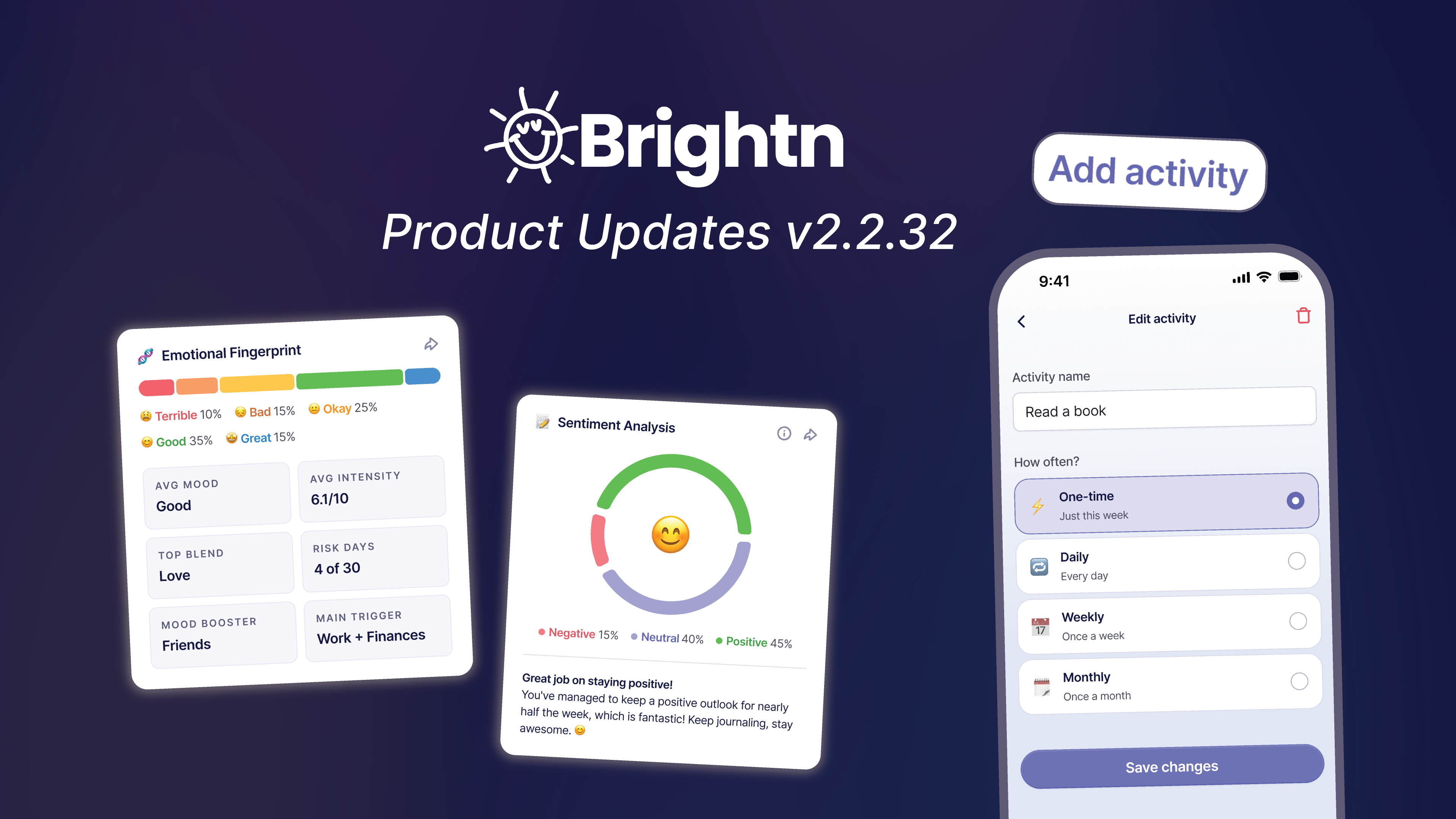
Track your patterns: You can't improve what you don't measure. Use a simple tool to log your mood, energy, and sleep quality over time. Brightn helps you identify patterns and triggers you might not notice on your own, offering personalized insights based on your unique mental health data.

Schedule non-negotiable recovery time: Just like you schedule meetings and appointments, block time for activities that restore your mental energy. This might be reading, creating art, being in nature, or literally doing nothing. Productivity culture tells us rest is earned, but the truth is rest is a biological requirement.
Reframe "self-care": Self-care isn't spa days and bubble baths (though those are nice). Real self-care often looks like setting boundaries, having difficult conversations, addressing problems you've been avoiding, or asking for help. It's whatever protects your peace and energy in the long term, even if it's uncomfortable in the short term.
Sometimes everything feels off because something genuinely needs professional attention. If your mental health reset doesn't shift the heaviness, or if you notice any of these signs, it's time to talk to someone:
There's no prize for struggling alone. Therapy isn't a last resort—it's a tool for understanding yourself better and developing strategies that actually work for your brain and your life.
Mental health isn't a problem to solve once and check off your list. It's something you tend to, adjust, and recalibrate as your life changes. The "off" feeling isn't a personal failure—it's information. Your brain is trying to tell you something needs attention.
The reset gives you space to hear what that is. What happens next is about building a life that supports your mental health by default, not as an afterthought when things get bad enough to demand it.
Start small. Start today. And remember: feeling off doesn't mean you're broken. Sometimes it just means you're human, and you're due for a reset.
Ready to take control of your mental wellness journey? Download Brightn to track your patterns, identify triggers, and get personalized insights that help you understand what your brain needs to thrive. Available on both iOS and Android.