Emilie Mauricio
January 15, 2026
•
4 min read
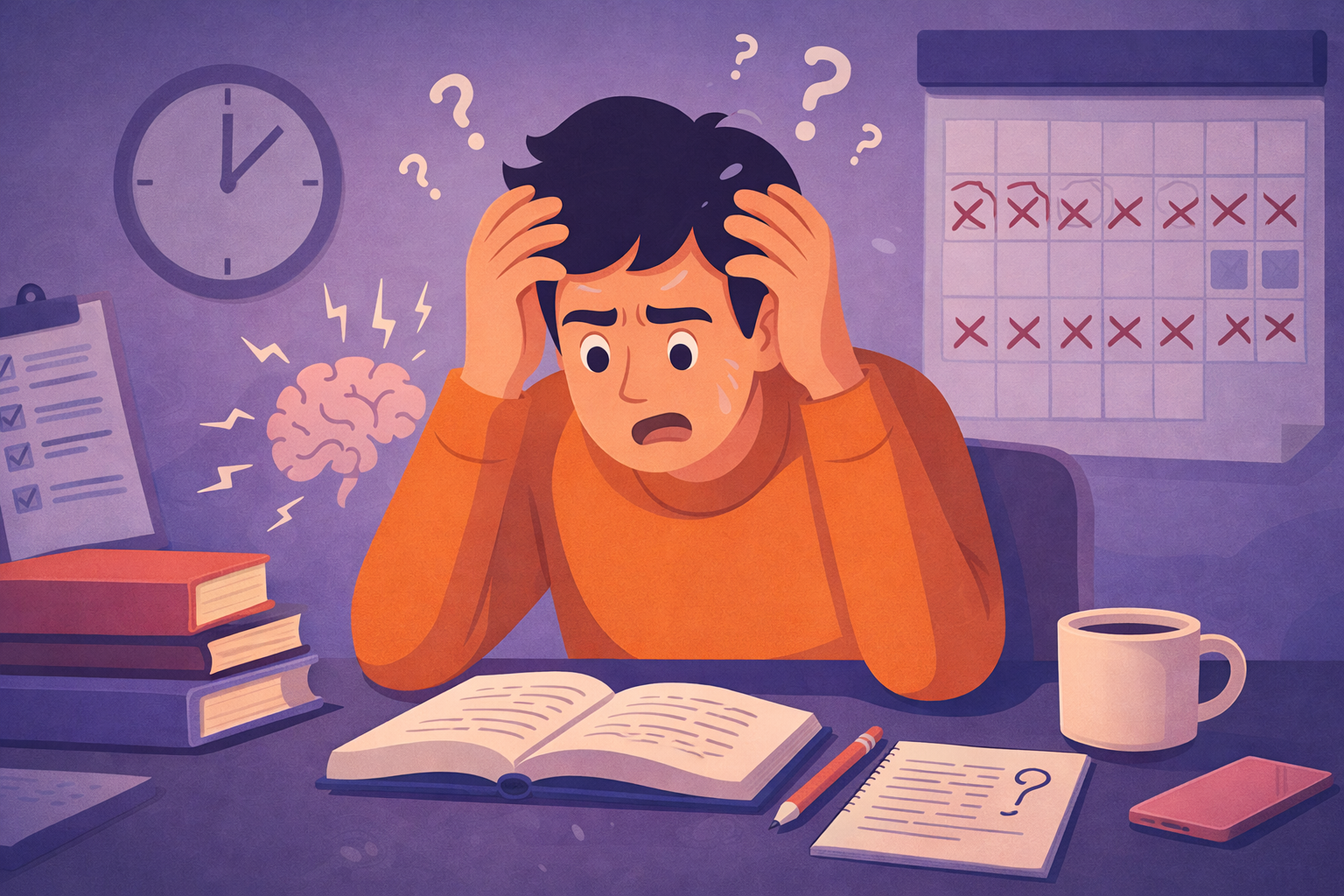
Finals week hits the same way every semester – stacked deadlines, cumulative exams, and mounting pressure. You start with good intentions, but somewhere between the second all-nighter and third energy drink, your plan falls apart.
Research reveals that finals are the primary source of stress for nearly one-third of college students. Even more concerning, 68% of students say their mental health has impacted their academic performance at least one day per month.
The paradox? The more pressure you feel, the harder it becomes to focus, retain information, and think clearly.
Your brain isn't failing you – it's responding exactly as evolution designed. Stress negatively affects cognition and working memory through harmful effects on the prefrontal cortex and hippocampus. Translation: stress chemicals literally impair your ability to learn and remember when you need those abilities most.
Three Critical Problems:

Most college students need 7-9 hours of sleep for optimal performance. After two weeks of sleeping six hours or less, students perform as poorly as someone who's gone 48 hours without sleep.
Quick wins:
The Pomodoro Technique (25-minute study blocks with 5-minute breaks) works because focused attention naturally wanes after 25-30 minutes.
Break down tasks: Instead of "study for biology exam," try "review chapter 7 notes for 25 minutes." Specificity reduces decision fatigue and makes starting easier.
Mindfulness meditation significantly reduces stress and anxiety in college students. Before major study sessions or exams, take 3 minutes to ground yourself:
Students who practice mindfulness report lower stress and higher quality of life.

Negative self-talk increases stress and creates unnecessary pressure. Try cognitive reframing:
❌ "I'm going to fail this exam"
✅ "I'm anxious about this exam. I'll focus on what I can control – my preparation"
❌ "I should be studying right now"
✅ "Studying feels hard. I'll focus for one hour, then take a break"
When stressed, self-care can feel like another chore. Lower your standards:
Finals week doesn't have to wreck your mental health. Brightn provides tools that support both your cognitive performance and emotional wellbeing:
AI-powered journaling and mood tracking helps you identify: Do you study better after exercise? Does anxiety spike at specific times? Which strategies leave you energized versus drained?
Customizable weekly planners let you structure study time alongside self-care – so academic goals don't cannibalize the practices that make learning possible.
Emotional grounding tools – guided journaling, breathwork exercises, and reflection prompts – help you calm your nervous system before attempting to focus.
Using your Brightn Zone and Life Statement, identify what actually matters to you. When your strategy reflects your real priorities rather than fear-based pressure, discipline becomes easier.
Download Brightn and build a finals week approach that supports both your performance and your peace.
Why does stress make it harder to study?
Stress releases hormones that interfere with brain regions responsible for learning and memory. Cramming while anxious produces worse results than studying less with a calm nervous system.
How much sleep do I need?
7-9 hours for optimal cognitive function. Sleep is when your brain consolidates information into long-term memory.
What if I'm too anxious to focus?
Don't force it. Spend 5-10 minutes on grounding exercises first. Studies show mindfulness interventions significantly reduce anxiety in students. Try Brightn's guided tools for structured support.
How do I stop comparing myself to others?
Limit exposure to peer conversations about grades. Use Brightn's journaling feature to redirect focus to your own progress. The only comparison that matters is where you are now versus yesterday.

Almarzouki, A.F. (2024) 'Stress, working memory, and academic performance: a neuroscience perspective', Stress, 27(1). Available at: https://www.tandfonline.com/doi/full/10.1080/10253890.2024.2364333
American College Health Association (2024) Student Reference Group Data Report Fall 2024. Available at: https://www.bestcolleges.com/research/college-student-mental-health-statistics/
Bamber, M.D. and Schneider, J. (2016) 'Mindfulness-based meditation to decrease stress and anxiety in college students', Educational Research Review, 18, pp. 1-32.
Healthy Minds Network (2025) Healthy Minds Study 2024-2025. Available at: https://sph.umich.edu/news/2025posts/college-student-mental-health-third-consecutive-year-improvement.html
Hershner, S.D. and Chervin, R.D. (2014) 'Causes and consequences of sleepiness among college students', Nature and Science of Sleep, 6, pp. 73-84.
Complete references available at: https://www.brightn.app/resources