Emilie Mauricio
January 15, 2026
•
12 min read
You're anxious at 2am. You open a mental health app—the same one that "helped" last week.
You type: "I can't sleep. My mind won't stop racing."
The app responds: "That sounds difficult. Have you tried deep breathing?"
Wait—didn't this work last time? Or was that the meditation? Or... nothing?
The app has already forgotten.
Most AI mental health apps are ChatGPT in disguise. Same generic advice for everyone. No memory of what actually helped you. No understanding of your unique patterns.
Brightn works differently—and here's exactly how.
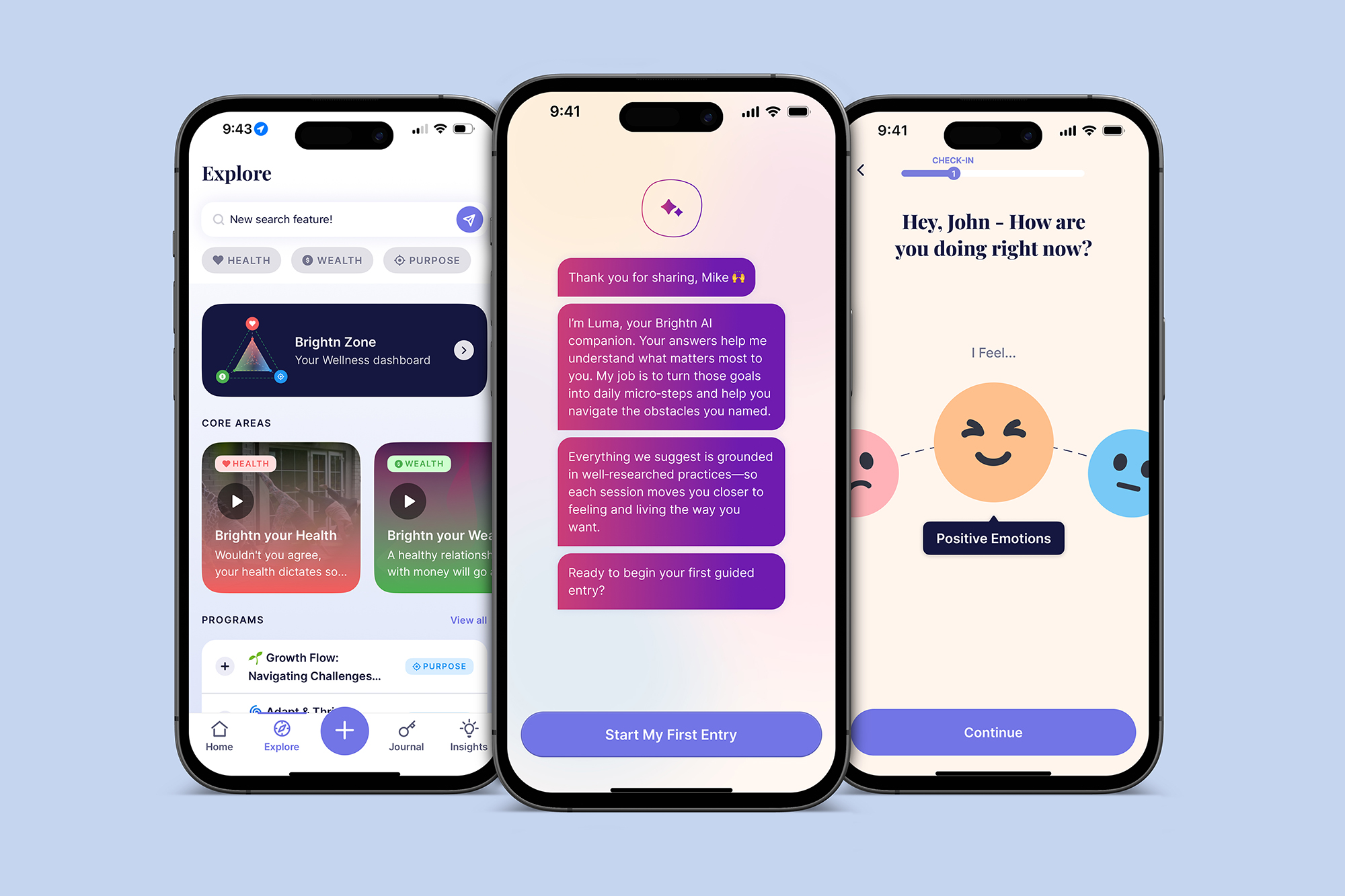
Brightn is different. Our AI companion, Luma, intelligently queries three comprehensive vector databases of evidence-based mental wellness content to provide personalized, clinically-informed support that adapts to your specific situation and mental wellness needs.
More importantly? Luma learns what works for you and gets smarter with every interaction.
Download Brightn to experience AI mental wellness that actually adapts to you.
Generic advice isn't just unhelpful—it's defeating.
When you're struggling and an app gives you the same suggestion it gave you yesterday (that didn't work), you start to think:
None of those are true.
The truth? Most apps rely on general language models trained on internet text—not clinical knowledge. They can't learn what works for YOUR brain. They can't remember what helped you last Tuesday. They can't adapt to your patterns.
It's like having a therapist with amnesia who read a self-help book once.

Instead of hoping a general AI would stumble into good advice, we built something fundamentally different: three specialized vector databases of evidence-based content, with an AI companion named Luma trained to intelligently query them based on your specific situation, emotional state, and what's worked for you before.
Think of it like this:
Other apps = A friend with good intentions but no memory and a limited vocabulary
Brightn = A companion with access to 30 years of clinical research, perfect memory of your journey, and the intelligence to know exactly which technique will help you right now
Here's how we did it.
What makes it different: Real therapeutic techniques from actual clinical practice—not internet advice
Our first database contains specific protocols from the therapeutic approaches psychologists actually use:
Cognitive Behavioral Therapy (CBT) Techniques
CBT helps you identify and change negative thought patterns that fuel anxiety and depression. When you express negative self-talk, Luma automatically queries proven CBT techniques for cognitive restructuring.
Particularly effective for: Depression, anxiety, PTSD, OCD, eating disorders, ADHD
CBT is Luma's go-to framework for thoughts.
Dialectical Behavior Therapy (DBT) Skills
DBT provides four core skill sets: mindfulness, distress tolerance, emotional regulation, and interpersonal effectiveness. When Luma detects emotional overwhelm, it queries the appropriate DBT intervention—especially valuable for people who feel emotions intensely.
DBT is Luma's framework for emotions.
Acceptance and Commitment Therapy (ACT)
ACT combines mindfulness with behavior change. Luma queries ACT when detecting values conflicts or avoidance patterns. It teaches psychological flexibility—staying present with difficult experiences while taking values-aligned action. Mindfulness keeps you grounded in the present.
ACT is Luma's approach for values.
Solution-Focused Brief Therapy (SFBT)
SFBT focuses on what's already working and how to do more of it—deriving solutions from your current strengths rather than dwelling on problems.
Motivational Interviewing (MI)
MI helps you resolve mixed feelings about change and build motivation for lasting behavior shifts. Luma queries MI techniques when detecting resistance to change.
How Luma chooses the right approach:
Pattern recognition matches your situation to the therapeutic framework that will help most:
Why this matters: These aren't random tips. These are research-backed approaches with decades of clinical validation.

Generic AI: "Try to think more positively"
Brightn's Luma: "I notice you're experiencing all-or-nothing thinking. Let's use a CBT technique called thought examination. What's one piece of evidence that challenges this absolute statement?"
The gap isn't subtle. One offers a platitude. The other offers a specific, evidence-based technique tailored to your exact thought pattern.
Try Brightn free and experience the difference immediately.
What makes it different: Organized by what's worked for YOU specifically
Our second database doesn't just contain coping strategies—it tracks which ones actually help your brain and prioritizes those first.
Emotional Regulation (ER) Strategies
Organized by emotional state and intensity. When you're overwhelmed, Luma queries your most effective past strategies first, then suggests new evidence-based alternatives.
Stress Management (SM) Techniques
Categorized by stress type (work, relationship, financial, health) and includes evidence-based techniques for activating your parasympathetic nervous system.
Anxiety Reduction
Both immediate relief (like 5-4-3-2-1 grounding) and long-term strategies. Luma tracks which techniques work for your specific anxiety triggers.
Depression Management
Behavioral activation, mood-boosting activities tailored to your interests, and techniques for challenging depressive patterns.
Crisis Management
Immediate safety strategies and de-escalation techniques with location-aware resources. Luma automatically queries crisis protocols when detecting keywords or patterns indicating acute distress.
The personalization difference:
You're anxious. Luma suggests deep breathing. It doesn't help much.
You're anxious again. Luma tries grounding techniques. You feel noticeably calmer.
Next time anxiety hits, Luma remembers. Luma immediately offers grounding-based strategies and skips what didn't work.
Over time, Luma becomes an expert on you.
What makes it different: Explains WHY you're experiencing what you're experiencing
Sometimes understanding is half the battle. This database helps you make sense of your mind.
Mental Health Fundamentals
Accessible education about how thoughts, feelings, behaviors, and physical sensations connect. Luma queries this when you ask "why" questions or express confusion.
Common Mental Health Conditions
Educational information (not diagnosis) about the difference between everyday sadness and clinical depression, normal anxiety versus anxiety disorders, and when professional support helps.
Wellness Domains
Content covering health, wealth, and purpose—helping you understand how different life areas impact your mental wellness and how to build balance.
Life Transitions
How major changes affect mental wellness, with strategies for navigating transitions while maintaining balance.
Smart education delivery:
Luma doesn't dump information on you. Luma provides relevant context exactly when you need it—when understanding a concept might help you move forward.

The real breakthrough happens when these databases integrate through Luma's sophisticated query system.
Example: Suggest Mode
You say: "I keep procrastinating on important work and then feeling terrible about myself."
What happens behind the scenes:
"I hear the frustration in that cycle—procrastinating, then the self-criticism hits hard.
Here are 3 personalized strategies: • Try the 2-minute rule: commit to just 2 minutes of work (often you'll keep going) • Use the grounding technique that helped you last week when overwhelmed • Schedule one small task for today—what feels manageable?
Which resonates most? I can guide you through it."
Example: Journal Mode
You write: "I'm so anxious about this presentation. I always mess these up."
Luma's response (following the therapeutic framework):
"That anxiety feels really heavy right now, especially with that 'always' thought pattern weighing on you.
It seems like past presentations might be shaping how you're seeing this one—even before it happens.
What evidence do you have that supports vs. challenges that 'always' thought?"
Generic AI response to the same scenario: "Procrastination can be frustrating. Try breaking tasks into smaller pieces and practicing self-compassion."
See the difference? Luma applies specific frameworks, references your history, and guides you through evidence-based techniques. Generic AI gives advice that could come from a fortune cookie.
Here's the revolutionary part: You get evidence-based support from your very first conversation. But unlike other apps that stay the same forever, Luma learns from every interaction and becomes increasingly tailored to you.
How continuous learning works:
From the start: Luma provides evidence-based techniques drawn from decades of clinical research
As you interact: Luma notices which suggestions you find helpful and which techniques you actually use
With each conversation: Luma identifies your unique emotional patterns and preferred coping styles
Over time: Luma recognizes your triggers before you do and proactively offers strategies that work for your brain
The result: You respond better to CBT's logical approach than DBT's emotional validation? Luma learns your therapeutic "language." Your anxiety spikes on Sunday evenings? Luma will recognize the pattern and help you prepare.
Three learning mechanisms working continuously:
Intervention Effectiveness Tracking: Monitors which suggestions you find helpful and which techniques you actually use
Pattern Recognition Enhancement: Identifies your unique emotional patterns and preferred coping styles
Personalized Framework Preferences: Learns which therapeutic approaches work best for your brain
The support you get today is excellent. The support you get as Luma learns you? Exceptional.
Start your journey with Brightn—get evidence-based support immediately that gets even better over time.
The databases aren't just for everyday stress—they're life-saving when stakes are highest.
What makes crisis support different:
Automatic Detection: Keyword analysis ("suicide," "self-harm"), sentiment shifts, behavioral changes, and context awareness trigger Crisis Mode immediately.
Hyper-Personalized Hope: "Based on your strength in overcoming work stress last month, remember your deep connection to your family—they need you here. This pain is temporary. You have so much purpose ahead. Life is worth living."
Evidence-Based Immediate Relief: DBT's TIPP method (Temperature, Intense exercise, Paced breathing, Paired muscle relaxation) adapted to your known preferences.
Location-Aware Resources: With your consent, Luma provides local crisis resources first, then national. The goal is simple: save lives by affirming worth and providing relief.
Generic AI might miss crisis indicators or give inappropriate responses. Luma's evidence-based protocols, combined with knowledge of your personal strengths, ensure you get the right support when you need it most.
Journal Mode: Empathetic reflection using therapeutic frameworks. Luma connects to your past reflections and guides you deeper.
Suggest Mode: 3-5 personalized strategies from all three databases, prioritized by your effectiveness history. Includes guided practical exercises.
Voice Mode: Warm, conversational guidance (40-85 words) that seamlessly integrates therapeutic frameworks in natural speech.
Crisis Mode: Enhanced safety protocols with personalized hope messaging and immediate relief techniques. Activates automatically when needed.
Intervention Mode: Guided therapeutic exercises using evidence-based techniques. Luma applies the right framework (CBT for thoughts, DBT for emotions, ACT for values) and tracks what resonates.
Before Luma delivers any suggestion, it runs through quality assurance:
✓ Queried relevant databases for evidence-based content
✓ Integrated your past successful strategies
✓ Applied appropriate therapeutic framework
✓ Maintained safety protocols
✓ Personalized to your current context
Plus transparency you can trust: Luma tells you which therapeutic approach it's using ("I'm drawing from DBT distress tolerance techniques here..."). You learn which frameworks work best for you while building trust through clarity.
The difference between Brightn and other mental health apps isn't subtle—it's transformational.
You get support that's:
Evidence-based: Every suggestion rooted in proven therapeutic approaches, not internet advice
Actually personal: Adapts to your unique patterns, preferences, and effectiveness history—not one-size-fits-all responses
Comprehensively intelligent: Draws from clinical research, coping strategies, and educational content simultaneously
Continuously learning: Gets more effective for your specific needs with every interaction
Crisis-aware: Sophisticated safety protocols that know your personal strengths and resources
You deserve mental wellness support that remembers you.
That understands the difference between Sunday anxiety and Tuesday stress. That knows grounding works for you but breathing exercises don't. That recognizes your patterns before you do and helps you navigate them with proven techniques tailored to your brain.
You deserve support that gets smarter about you, not just smarter in general.
That's what we built.
Your mental wellness deserves more than generic responses that forget you exist. It deserves an AI companion like Luma who understands, remembers, and grows with you using the best of human psychological science.
Download Brightn now and discover what happens when mental wellness support is built on clinical intelligence, evidence-based frameworks, and genuine personalization that learns what works for your brain.